
Evaluating Adhesive Bonds with the Newton Control System
ASTM D1002 requires precise alignment and high-frequency data capture to accurately identify the peak breaking force of thin-metal adhesive bonds. Leveraging our advanced control system paired with either the Newton 140-2250 (10kN) or Newton 313 (50kN) electromechanical frames to ensure unmatched data integrity and specimen alignment.
Newton Advantage: Digital Excellence in Materials Testing
32-Bit Data Acquisition: Precision Beyond the Peak
Most industry-standard controllers operate on 16-bit or 24-bit architectures. While those are fine for “crush and snap” tests, they lack the granularity required for R&D. A 32-bit system provides over 4 billion discrete digital counts. This allows the Newton package to detect microscopic “pre-failure” events – tiny fractures in the adhesive matrix – long before the catastrophic break occurs. You aren’t just getting a peak load; you’re getting a high-definition movie of the bond’s life cycle.
100,000 Signal-to-Noise Ratio (SNR)
In electronic testing, “noise” is the enemy. It is the static that hides the signal. A 100,000:1 SNR means your data is essentially “laboratory grade” right out of the box. Low-quality controllers often show “fluctuations” that look like material properties but are actually just electrical interference. Because the noise floor is so low, Newton can accurately test extremely thin films or low-strength pressure-sensitive adhesives (PSAs) on the same frame used for high-strength structural epoxies.
Synchronous Dual-Channel Sampling
Newton doesn’t just look at load; it looks at load and strain (displacement) in perfect harmony. Zero Lag: By sampling both the load cell and the extensometer (or crosshead) on the same 32-bit clock, the Newton ensures that every data point on your stress-strain curve is perfectly aligned in time. This is critical for calculating the Shear Modulus, where a millisecond of lag can skew your results.
This plot demonstrates the “Newton Advantage.” It compares the load-displacement response of an ASTM D1002 test as “seen” by a conventional system versus your 32-bit controller.
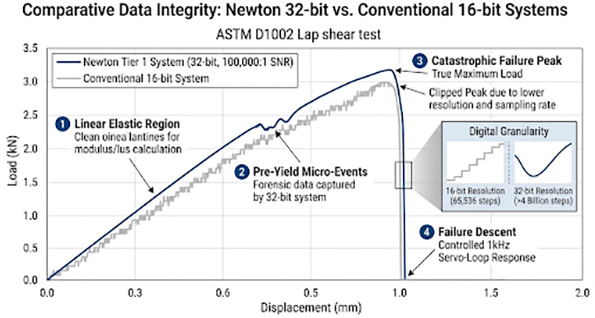
Here are the key aspects that align with our discussion:
- Notice the moment of bond break, contrasting the clean, sharp “Newton” peak against a conventional peak that is often rounded or “clipped” due to slower data capture.
- Noise Visualization: Notice the linear-elastic region (the slope). The Newton data is represented as a perfectly clean line, while the conventional data (shown as a faded, jagged curve) illustrates the quantization noise that is eliminated by your 100,000:1 SNR.
- Digital Granularity Inset: I added a specialized inset graphic. This provides a focused, schematic-style comparison of how 32-bit resolution provides over 4 billion discrete data counts, effectively rendering the smooth analog response of the adhesive bond.
Adaptive Control Loop
Beyond just recording data, the Newton package uses its processing power to manage the machine’s behavior. Constant Rate of Extension (CRE): ASTM D1002 mandates a specific loading rate. The Newton’s high-speed servo-loop adjusts the motor output thousands of times per second to ensure that the crosshead speed never wavers, regardless of how much the specimen resists.
Comparison Table: Newton vs. Competing Controllers
| Feature | Standard Controller (16/24-bit) | Newton (32-bit) |
|---|---|---|
| Data Granularity | ~65,000 to 16M counts | > 4 Billion counts |
| Noise Floor | High (can mask small events) | Ultra-Low (100,000 SNR) |
| Application Suitability | R&D, Forensic Analysis, Aero | |
| Software Integration | Static Templates | Dynamic, User-Defined Analysis |
Technical Specifications: ASTM D1002 Test Systems
| Feature | Model 140-2250 | Model 313 |
|---|---|---|
| Primary Application | Affordable High-Precision Lap Shear | High-Strength Structural Bonding |
| Max Frame Capacity | 10 kN (2,250 lbf) | 50 kN (11,250 lbf) |
| Control Package | Newton Tier 1 | Newton Tier 1 |
| Signal-to-Noise Ratio (SNR) | 100,000 | 100,000 |
| Data Sampling Rate | Optional to 5 kHz | Optional to 5 kHz |
| Recommended G154 Grips | Side-Opening Screw Action | Side-Opening Screw Action |
| Grip Offset Adjustment | 0 to 10 mm (Adjustable) | 0 to 15 mm (Adjustable) |
| Software Interface | Newton Analysis (N-D1002) | Newton Analysis (N-D1002) |
| Power Requirements | 110/220V Single Phase | 110/220V Single Phase |
Notable System Features
- Auto-Recognition: Both frames feature plug-and-play recognition for load cells and extensometers, ensuring that 32-bit resolution is maintained across all connected sensors.
- Adaptive Servo-Control: The Newton package utilizes a high-speed control loop to maintain the constant rate of extension (CRE) required by ASTM D1002, regardless of specimen stiffness changes.
- Data Export: High-density data can be exported in .csv or .xml formats for advanced forensic analysis in third-party math software, preserving the full 32-bit fidelity.
- Side-Opening G154 Screw Action Vice Grips with adjustable offset. Since lap shear specimens are offset by the thickness of the bond, the grips must adjust to maintain a true vertical load path. Note: This avoids induced peeling stresses that invalidate the test.