
ASTM D412 is the primary benchmark for evaluating the tensile properties (ultimate elongation, tensile set, and tensile strength) of thermoset rubbers and thermoplastic elastomers. The primary “Measurement Gap” stems from the extreme viscoelasticity and high elongation of rubbers, which routinely stretch 500% to 1000% before breaking. Traditional mechanical clip-on extensometers are completely inadequate as they are too heavy, run out of physical travel, and create sharp “stress risers” that cause premature specimen failure. Furthermore, elastomers exhibit severe cross-sectional thinning (“necking”) during extension; manual screw-action grips fail to compensate for this thinning, resulting in catastrophic specimen slippage and ruined strain data.
To meet the requirements of ASTM D412, MTO recommends the TestResources 240-500-1400 high-travel single-column load frame integrated with Newton Characterization™ architecture.
Primary Metric: This configuration enforces a Constant Rate of Extension (CRE) control mode , driving the crosshead at a Compliant, standardized fast velocity of 500 mm/min. This high speed prevents thermal recovery and ensures the rubber remains warm and elastic during deployment.
Specimen Geometry: Tests are conducted using die-cut “Dumbbell” (typically Die C) or cut-ring geometries. All samples must be razor-cut cleanly; any microscopic edge nicks act as critical stress concentrations that trigger early failure.
Critical Ratios: For valid modulus calculations, the system must synchronize high-velocity travel with a long-travel strain path to continuously map mathematically smooth stress-strain behavior as the material geometry transforms.
Problem: Elastomer testing data is frequently corrupted by “stair-step” noise curves and false force peaks in highly elastic zones. This noise distorts calculations at common benchmark extension points (such as the 100% or 300% modulus).
Root Cause: Standard 24-bit controllers generate quantization errors when synchronizing motor encoders with the high-frequency displacement of dynamic elastomers. Additionally, manual grips allow the specimen to slide out as tensile force forces the rubber to thin out dynamically under load.
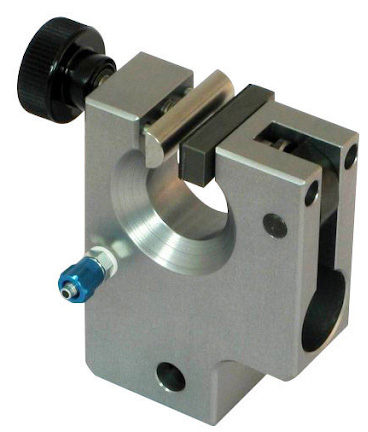
Hardware Solution: MTO recommends utilizing Pneumatic Side-Action Grips equipped with a dual-stage regulation system to maintain a constant, unyielding clamping pressure as the specimen necks down.
For strain tracking, mechanical clip-ons must be completely bypassed in favor of TestVE (Video Extensometry) using a specialized long-travel lens matrix. To prevent tracking failure and “stair-step” anomalies during high-speed expansion, operators must establish absolute target contrast by using a white or black paint pen to lay down sharp, blur-free gauge markings.
The Newton core provides 4.29 billion discrete measurement levels (256x greater resolution than 24-bit hardware), guaranteeing mathematically smooth stress/strain tracking through severe cross-sectional thinning.
Delivers a High-Resolution 100,000:1 ratio to completely silence mechanical frame rumble and electrical chatter.
Operates at a rapid 5 kHz data acquisition loop, locking onto the precise microsecond of terminal specimen rupture.

Event Detection: Features automated breakaway logic tuned for high-elongation recoil, capturing ultimate tensile break points while instantaneously protective-braking the crosshead.
Calculations: Automatically calculates Ultimate Elongation at break, Tensile Strength, Tensile Set, and Tensile Stress at specified extension intervals (100% and 300% Modulus).
Statistical Output: Compiles automated batch summaries detailing the Mean, Standard Deviation (SD), and manufacturing batch consistency across all specimens.
| Load Frame: | TestResources 240-500-1400 (High-Travel Single Column UTM) |
| Control Architecture: | Newton Characterization™ |
| Software Module: | N-ASTM-D412 |
| Grips/Fixtures: | G-ASTM-D412 (Pneumatic Side-Action Elastomer Grips) |
| Strain Measurement: | E-ASTM-D412 (TestVE Non-Contacting Video Extensometry) |