
ASTM D695 plays a critical role in establishing the compressive properties of unreinforced and reinforced rigid plastics. However, a major “Measurement Gap” exists due to the Compliance Paradox: the machine’s internal frame deflection or “squish” can easily dwarf the actual microscopic deformation of a high-stiffness polymer coupon. If an operator relies strictly on crosshead travel for modulus or yield calculations, the compliance of the system severely artificially softens the stress-strain curve, leading to highly inaccurate data. Furthermore, surface non-parallelism or improper alignment can induce localized edge-crushing or unexpected lateral movement instead of uniform structural loading.
To meet the requirements of ASTM D695, MTO recommends the TestResources 313-50-1200 integrated with Newton Characterization™ architecture.
Primary Metric: The machine operates under a constant crosshead speed of 1.3 mm/min, providing a uniform, constant strain rate control mode. This quasi-static control ensures stable loading sensitivity and prevents dynamic momentum from masking critical material transitions during compression.
Specimen Geometry: Tests are performed on unreinforced and reinforced rigid plastics prepared as solid cylindrical or flat prismatic blocks. Their top and bottom loading faces must be ground perfectly flat and parallel to eliminate multi-axial stress skew or sudden side-kicking during load application.
Critical Ratios: Specimen geometry is tightly constrained to fulfill specific mandated slenderness and thickness ratios. Choosing a specimen that is too slender shifts the testing state from true compression crushing into an invalid, global Euler buckling mode.
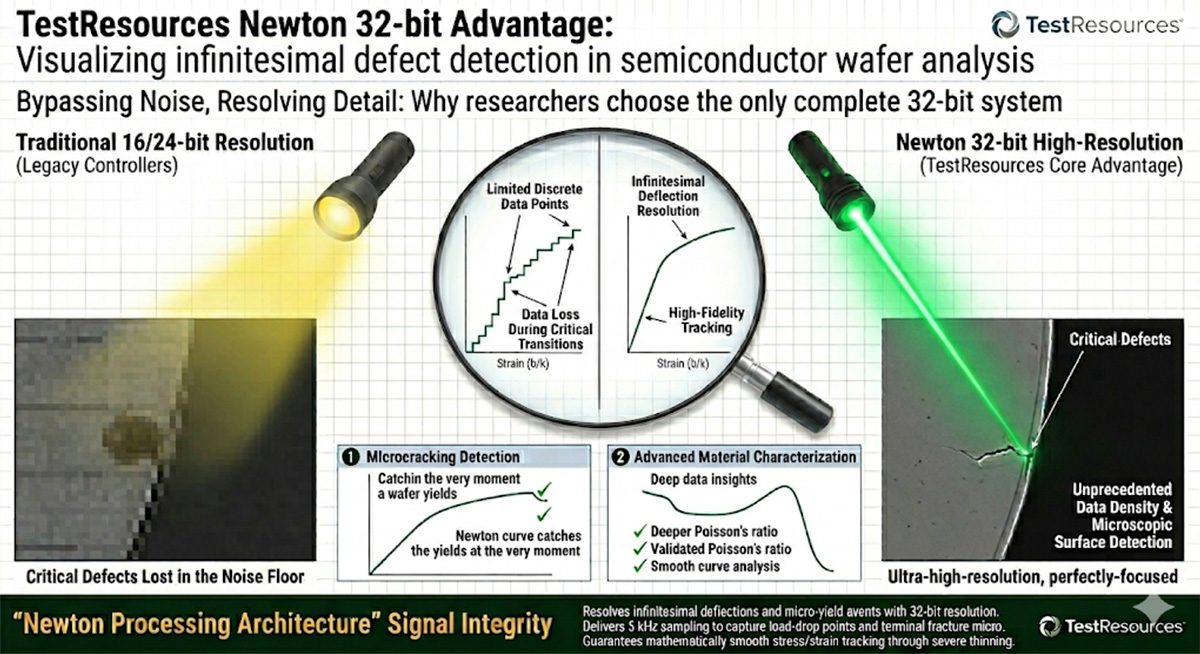
Problem: Brittle plastic compression curves are exceptionally prone to “stair-stepping” artifacts during the initial slope sequence. This electrical noise obscures the true proportional limit and alters the final offset yield parameters.
Root Cause: Standard 24-bit data acquisition channels suffer from quantization limitations. When processing tiny physical changes at the beginning of a compression cycle, the digital steps blur machine compliance with the actual material strain path.
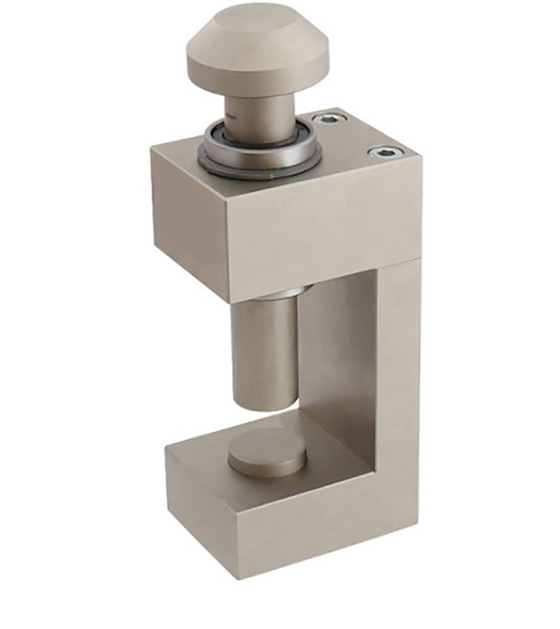
Hardware Solution: MTO recommends deploying a specialized G-ASTM-D695-F2 compression sub-press tool featuring a plunger guided by precision-ground bushings to achieve perfect vertical concentricity. Friction at the platen interface is minimized by applying a uniform micro-layer of PTFE or molybdenum disulfide lubricant to prevent barreling. Crucially, the configuration completely bypasses internal crosshead encoders for strain calculation by capturing platen-to-platen deflection directly via an E-ASTM-D695 Epsilon 3540 deflectometer.
The Newton processing architecture processes data across 4.29 billion discrete measurement levels. This is 256 times greater resolution than legacy 24-bit units, ensuring continuous tracking across extremely small displacement steps.
Operates at a High-Resolution 100,000:1 Signal-to-Noise Ratio to silence mechanical hum, building vibration, or electrical actuator chatter.
Commands a rapid 5 kHz data acquisition rate to map rapid load fluctuations or trace subtle fractures perfectly.
Event Detection: Employs an automated break and first-fracture monitoring utility. The frame reacts within a fraction of a millisecond to stop motor movement at specimen failure, shielding the high-stiffness sub-press tools from terminal damage.
Calculations: Automatically calculates Compressive Yield Stress (utilizing a mathematically robust 0.2% offset calculation), Young’s Modulus, and Ultimate Compressive Strength.
Statistical Output: Computes integrated batch matrices showcasing the statistical Mean, Standard Deviation (SD), and cross-specimen batch consistency for regulatory compliance.
| Load Frame: | TestResources 313-50-1200 |
| Control Architecture: | Newton Characterization™ |
| Software Module: | N-ASTM-D695 |
| Grips/Fixtures: | G-ASTM-D695-F2 |
| Strain Measurement: | E-ASTM-D695 (Epsilon 3540 Deflectometer / Compressometer) |