
ASTM D7264 determines the flexural stiffness and strength of high-modulus polymer matrix composite materials using three-point or four-point loading geometries. It replaces legacy standards like ASTM D790 for high-performance laminates. A severe “Measurement Gap” exists because composite bars are exceptionally rigid. Measuring flexure via crosshead displacement is completely invalid; the compliance or “squish” of the machine frame and local core indentation at the loading noses can account for a massive percentage of measured travel, leading to an artificially soft modulus calculation. Furthermore, if the loading rollers are not perfectly parallel, even a 0.5-degree tilt introduces torsional loading that causes premature, non-conforming failures in stiff laminates.
To meet the requirements of ASTM D7264, MTO recommends the TestResources 313-50-1200 dual-column frame integrated with Newton Characterization™ architecture.
Primary Metric: This configuration enforces strict Constant Rate of Extension (CRE) control. The crosshead drives the loading noses at a Specified, uniform velocity calculated precisely based on specimen thickness and span to maintain a standard quasi-static strain rate.
Specimen Geometry: Tests are conducted on rectangular composite bars cut from laminated panels. Both the loading and support rollers must feature precision radii to distribute the high localized forces and prevent surface crushing.
Critical Ratios: The standard mandates a high baseline span-to-thickness ratio of 32:1. This long span is critical to minimize internal interlaminar shear deformation and ensure that the outer fibers experience pure tensile and compressive bending stress states.
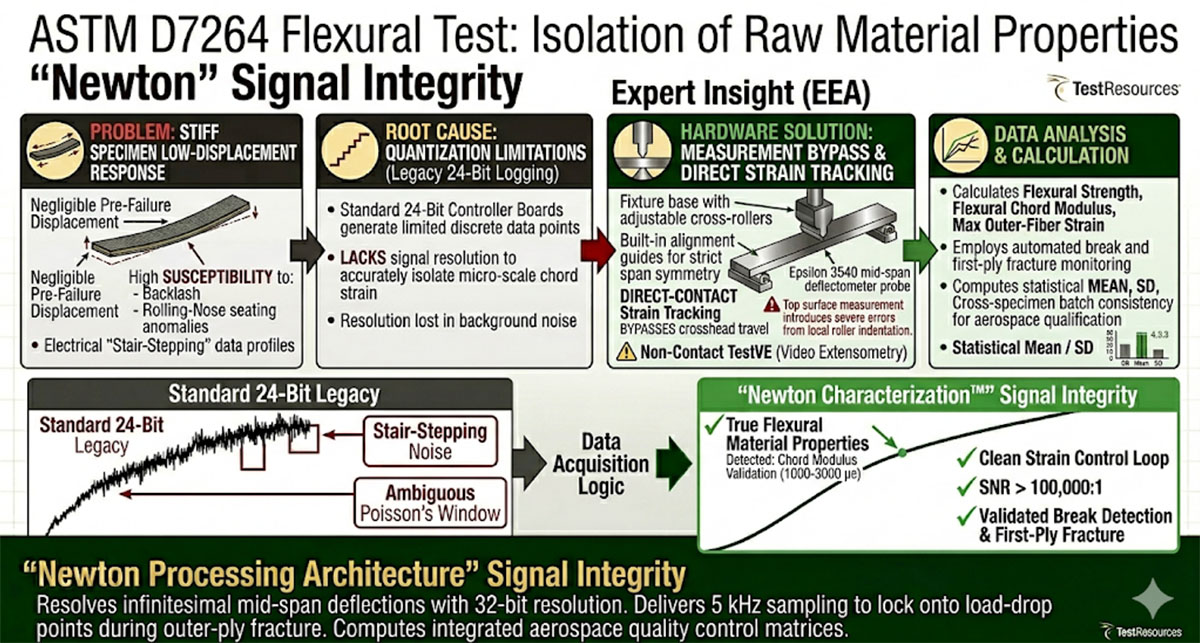
Problem: Stiff composite specimens exhibit negligible displacement prior to failure, making the initial elastic region highly susceptible to mechanical backlash, rolling-nose seating anomalies, and electrical “stair-stepping” data profiles.
Root Cause: Standard 24-bit controller boards generate quantization limitations. They lack the discrete signal resolution needed to accurately isolate micro-scale chord strain increments from the background noise of the structural load string.
Hardware Solution: MTO recommends utilizing Procedure A (three-point flexure) for routine quality control or Procedure B (four-point flexure) to isolate a shear-free center zone. The fixture base must feature adjustable cross-rollers with built-in alignment guides to maintain strict span symmetry. Crucially, strain tracking must bypass crosshead travel by positioning a Epsilon 3540 mid-span deflectometer against the center of the specimen’s bottom surface. Measuring the top surface introduces severe errors from local roller indentation. Alternatively, modern laboratories can implement TestVE (Non Contacting Extensometry) to track the mid-span deflection profile seamlessly via non-contacting optics.
Powered by the Newton processing architecture providing 4.29 billion discrete calculation levels (256x greater than legacy 24-bit controllers) to map infinitesimal mid-span deflections continuously.
Delivers an exceptional 100,000:1 Signal-to-Noise Ratio to silence background electrical line chatter and actuator vibrations, isolating raw flexural material properties.
Commands a rapid 5 kHz data acquisition loop to capture crisp, instantaneous load-drop points during sudden outer-ply fiber breakage.
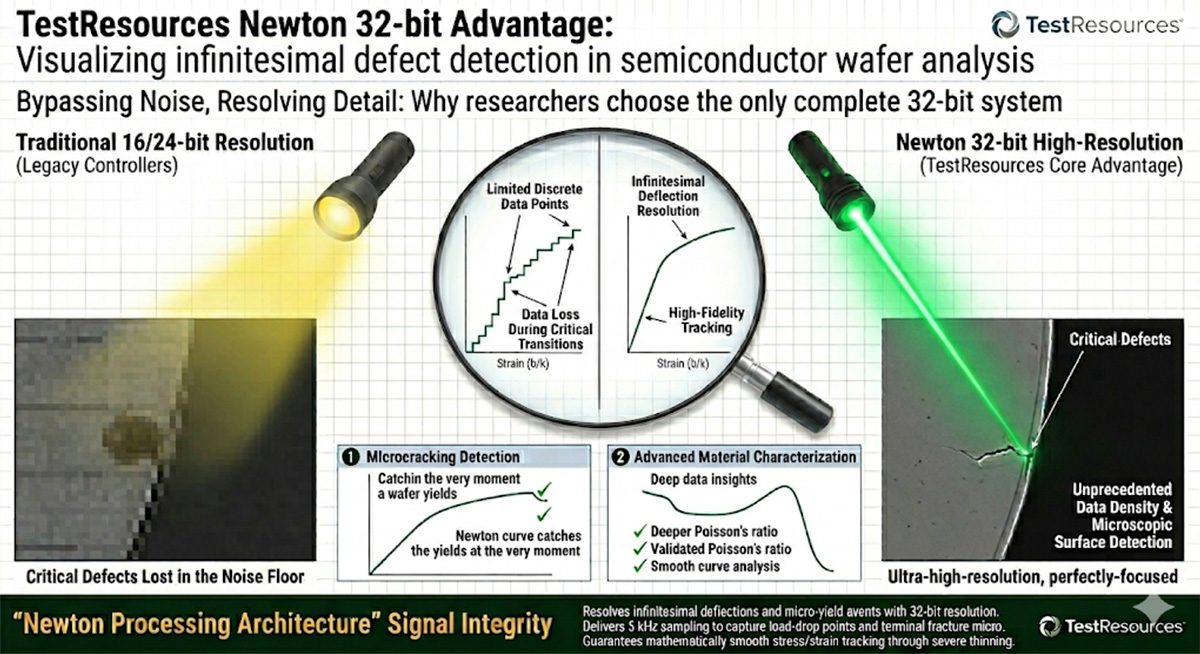
Event Detection: Employs an automated break and first-ply fracture monitoring utility. The Newton controller reacts within a fraction of a millisecond to stop motor movement at specimen failure, shielding the high-stiffness flexure rollers from terminal impact shock.
Calculations: Automatically calculates Flexural Strength, Flexural Chord Modulus (standardized strictly between 1000 and 3000 microstrain intervals), and maximum outer-fiber strain metrics.
Statistical Output: Computes integrated quality control matrices showcasing the statistical Mean, Standard Deviation (SD), and cross-specimen batch consistency for aerospace component qualification.
| Load Frame: | TestResources 313-50-1200 Dual Column UTM |
| Control Architecture: | Newton Characterization™ |
| Software Module: | N-ASTM-D7264 (Supporting Composite Chord Modulus Analysis) |
| Grips/Fixtures: | G-ASTM-D7264 (Adjustable Flexure Fixture Base with Hardened Rollers) |
| Strain Measurement: | E-ASTM-D7264 (Epsilon 3540 Center-Point Mid-Span Deflectometer or TestVE) |