
ASTM E466 dictates the parameters for determining the fatigue life of metallic materials under constant amplitude cyclic loading. This standard requires high-frequency execution capabilities, placing intense demands on load string precision. The primary “Measurement Gap” stems from the requirement for a highly tuned PID loop to manage dynamic force profiles: force-controlled fatigue necessitates an exceptionally responsive control sequence to prevent destructive “overshoot” during the critical first few cycles. Furthermore, any microscopic misalignment in the load string introduces a parasitic bending moment into what should be pure axial fatigue, severely artificially shortening the material’s fatigue life and scattering the resulting S-N data curve.
To meet the requirements of ASTM E466, MTO recommends the TestResources 820D6-50-250 integrated with Newton Fatigue™ architecture.
Primary Metric: This configuration enforces strict dynamic, force-controlled constant amplitude cycle loading. It operates entirely on continuous cyclical frequency control (typically ranging from 1 to 15 Hz based on specimen stiffness) rather than quasi-static linear speeds.
Specimen Geometry: Tests are conducted on metallic specimens machined into precise round or flat “hourglass” or straight-reduced profiles. Surface finish is an absolute priority; any scratches perpendicular to the load axis act as severe stress risers that prematurely initiate fatigue cracks.
Critical Ratios: The universal testing system must maintain extreme rigid axial alignment throughout millions of continuous cycles. The controller must hold a constant load amplitude despite gradual specimen softening as micro-cracks propagate.
Problem: Dynamic force-controlled testing is uniquely vulnerable to “Cycle Creep,” where the target peak and valley loads subtly drift over extended testing periods, distorting the calculated stress amplitude and invalidating long-term fatigue data.
Root Cause: Standard 24-bit data acquisition electronics can experience computational drift and synchronization lag when processing high-frequency peak/valley loops, struggling to maintain a tight grip on dynamic load limits as the material’s structural compliance transforms.
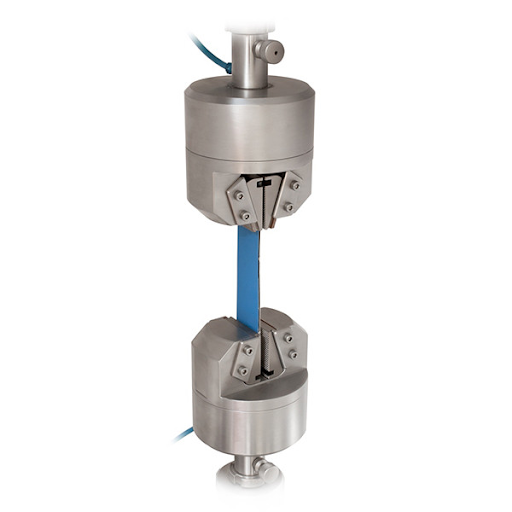
Hardware Solution: MTO mandates the use of a TestResources 800 Series servoelectric or high-frequency dynamic load frame configured for smooth waveform generation. The system may deploy High-Capacity Hydraulic Wedge Grips equipped with continuous side-clamping pressure to completely eradicate mechanical micro-slippage during high-speed direction reversals. For strain monitoring during initialization, a Class 0.5 fatigue-rated clip-on extensometer (Epsilon 3542) can be mounted. However, the core requirement is an ultra-stiff, fatigue-rated web shear pancake load cell to capture dynamic stress without internal signal ringing.
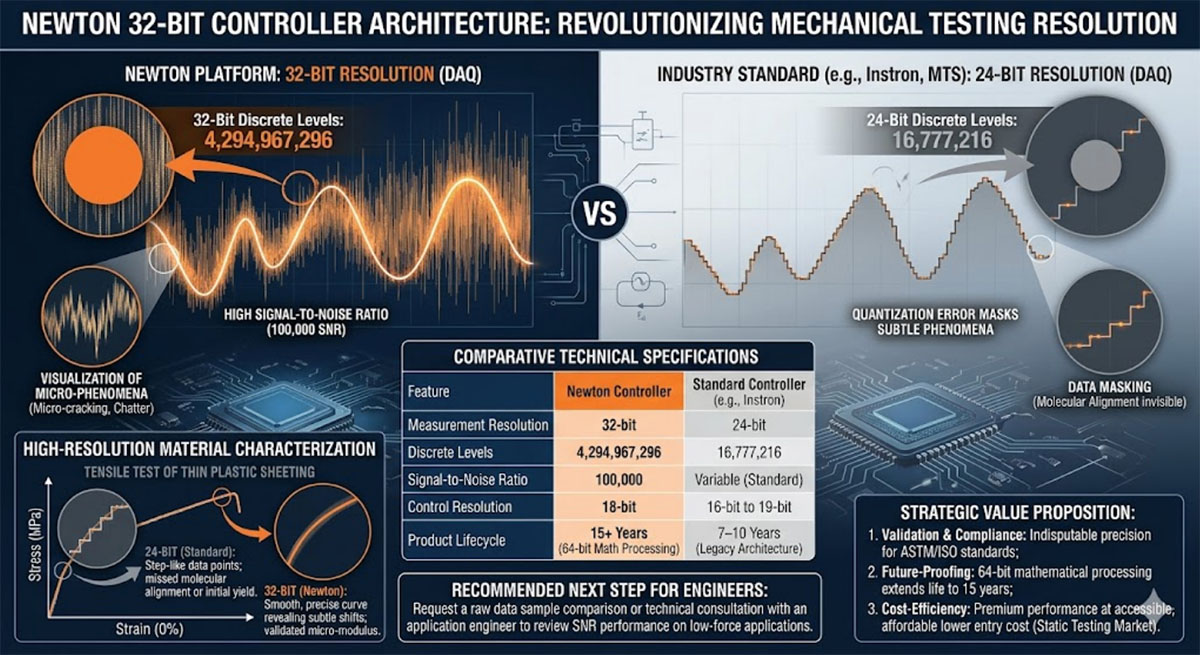
Powered by a high-speed digital signal processor rendering 4.29 billion discrete measurement levels (256x greater than legacy 24-bit processors) , allowing the Newton core to track and adjust real-time peak/valley boundaries with flawless consistency.
Provides a High-Resolution 100,000:1 Signal-to-Noise Ratio to isolate actual material fatigue phenomena and minute crack-initiation energy drops from background electrical and mechanical noise artifacts.
Commands an ultra-dense 5 kHz data acquisition rate , utilizing a high-speed 1 kHz dynamic buffering stream specifically to manage the peak/valley control loop over millions of operating cycles.
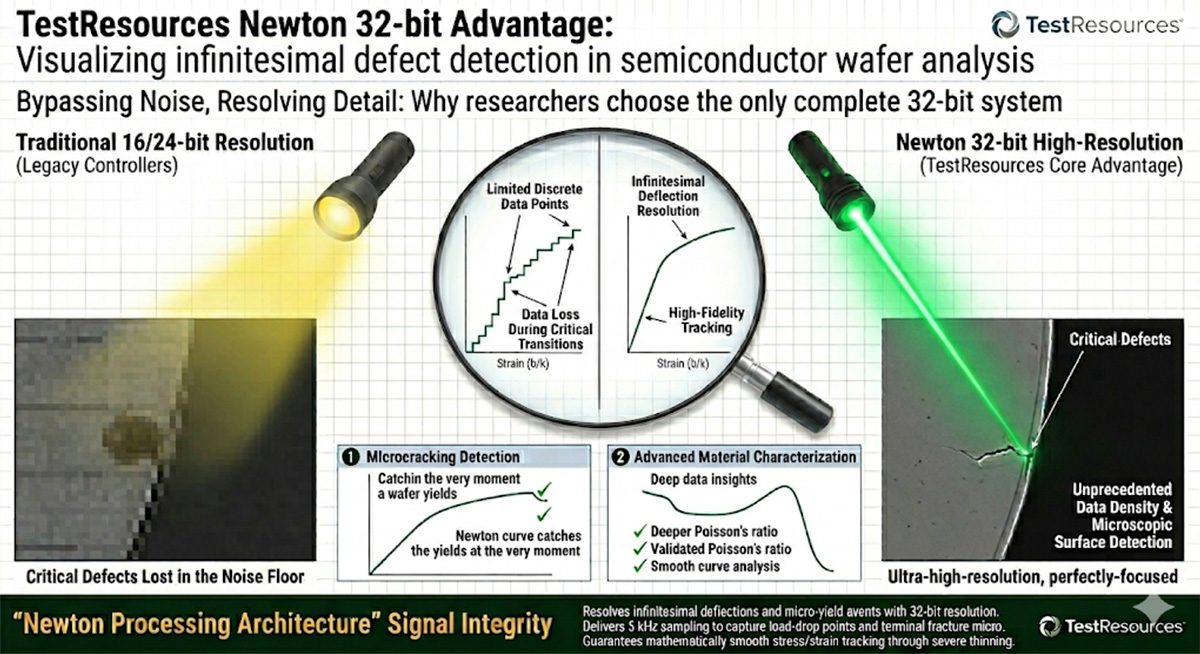
Event Detection: Utilizes sophisticated real-time tracking software to log dynamic stiffness decay. The frame automatically triggers a controlled system halt the millisecond a complete breakaway or crack fracture occurs, safely containing the high recoil energy.
Calculations: Automatically plots and processes complete S-N Curves (Stress vs. Cycles to Failure), capturing fatigue limit thresholds, plastic strain accumulation, and dynamic modulus decay.
Statistical Output: Generates extensive batch analytics computing the mean fatigue life, multi-specimen data scatter, and batch consistency metrics across identical stress levels.
| Load Frame: | TestResources 820D6-50-250 Dual Column Dynamic UTM |
| Control Architecture: | Newton Fatigue™ |
| Software Module: | N-ASTM-E466 (Dynamic Waveform & S-N Curve Analysis) |
| Grips/Fixtures: | G-ASTM-E466 (Pneumatic or Hydraulic Wedge Grips) |
| Strain Measurement: | E-ASTM-E466 (Epsilon 3542 Fatigue-Rated Clip-on Extensometer) |