
ASTM D6641 plays a critical role in determining the compressive strength and modulus of multidirectional polymer matrix composite laminates. Compression testing of high-stiffness laminates introduces a severe “Measurement Gap” due to the high risk of catastrophic Euler buckling and specimen macro-instability. To suppress buckling without inducing end-crushing, the standard utilizes a complex mechanism that introduces the axial force through a hybrid combination of shear-loading and end-loading. Any micro-scale geometric twist or misalignment within the testing load string creates non-uniform stress distribution, immediately invalidating the dataset if the front-to-back percent bending exceeds 10%
To meet the requirements of ASTM D6641, MTO recommends the TestResources 316-300-1130 dual-column frame integrated with Newton Characterization™ architecture.
Primary Metric: The system operates under a uniform Constant Rate of Extension (CRE) control mode. It maintains a Specified quasi-static crosshead speed of 1.3 mm/min to prevent sudden dynamic energy from prematurely shocking the stiff composite structure.
Specimen Geometry: Tests are executed on straight-sided rectangular composite plates, which can be tested either tabbed or untabbed due to the advanced load-introduction mechanics of the clamping system.
Critical Ratios: Tight control over fixture-to-specimen dimension ratios is mandatory. The unsupported gauge section must be kept minimal to ensure the matrix section experiences true ultimate material crushing rather than global buckling modes
Problem: Composite compression traces are highly vulnerable to parasitic friction loads and “stair-stepping” data profiles during the critical initial linear region, which masks the true compression modulus and skews structural data calculations.
Root Cause: Standard 24-bit controller logic generates quantization errors when resolving microstrain steps under high-force environments. Furthermore, if an operator over-tightens the assembly bolts, the friction force combines with the specimen force, generating an erroneously artificially high strength reading.
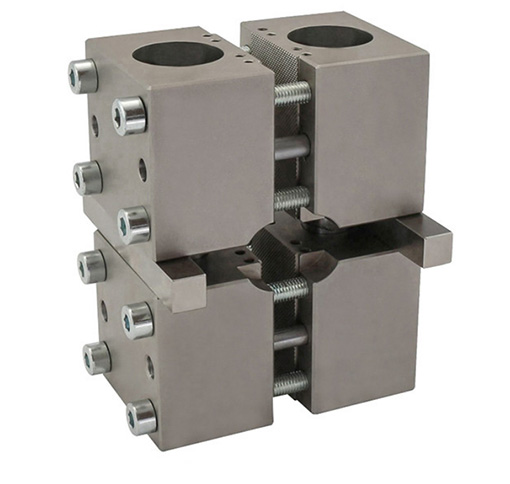
Hardware Solution: MTO recommends employing the specialized G-STD-D6641 CLC compression fixture featuring face-clamping blocks and adjustable tightening configurations. Technicians must apply a calibrated torque wrench to ensure side-support bolt pressure is locked exactly between 0.5 Nm and 1.0 Nm to mitigate parasitic friction. Crucially, back-to-back strain measurement is mandatory to actively monitor percent bending in real-time. Biaxial strain data should be tracked directly via paired strain gauges or a specialized TestVE (Video Extensometry) mirror configuration to capture both specimen faces simultaneously.
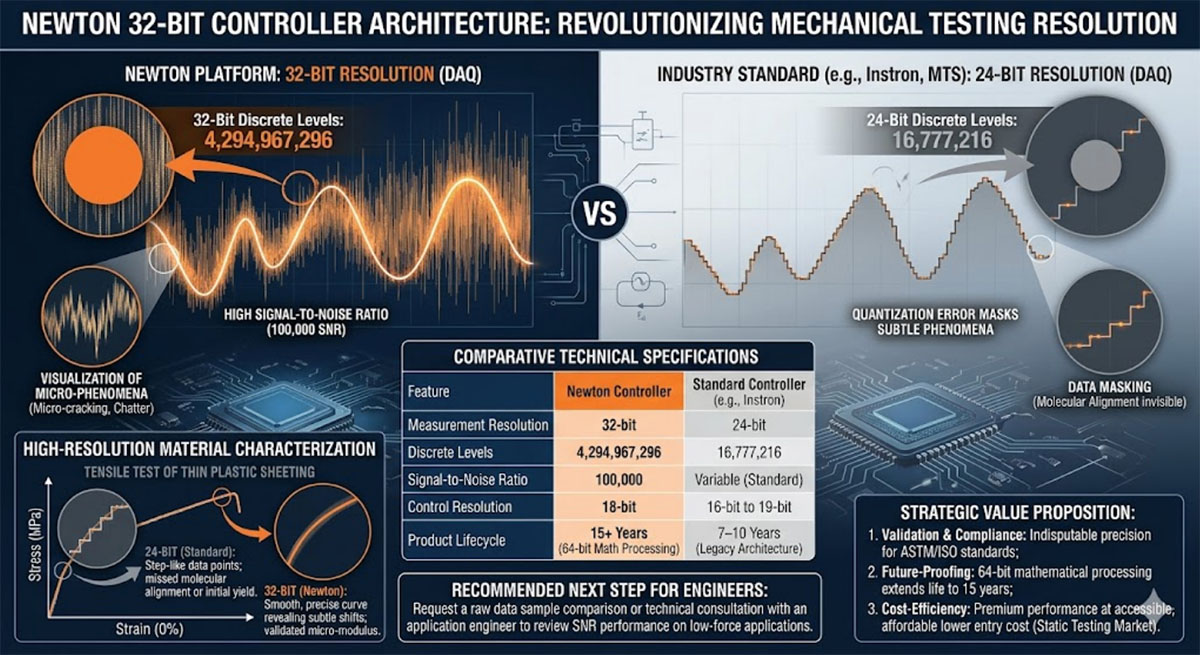
The Newton processing core tracks data across 4.29 billion discrete measurement levels (256x greater resolution than legacy 24-bit processors) to capture the composite compression profile smoothly without quantization steps.
Operates at a High-Resolution 100,000:1 Signal-to-Noise Ratio to completely silence electrical chiller artifacts and mechanical motor harmonics.
Commands high-speed data acquisition loops up to 5 kHz to lock onto high-energy matrix failures the exact millisecond they occur.
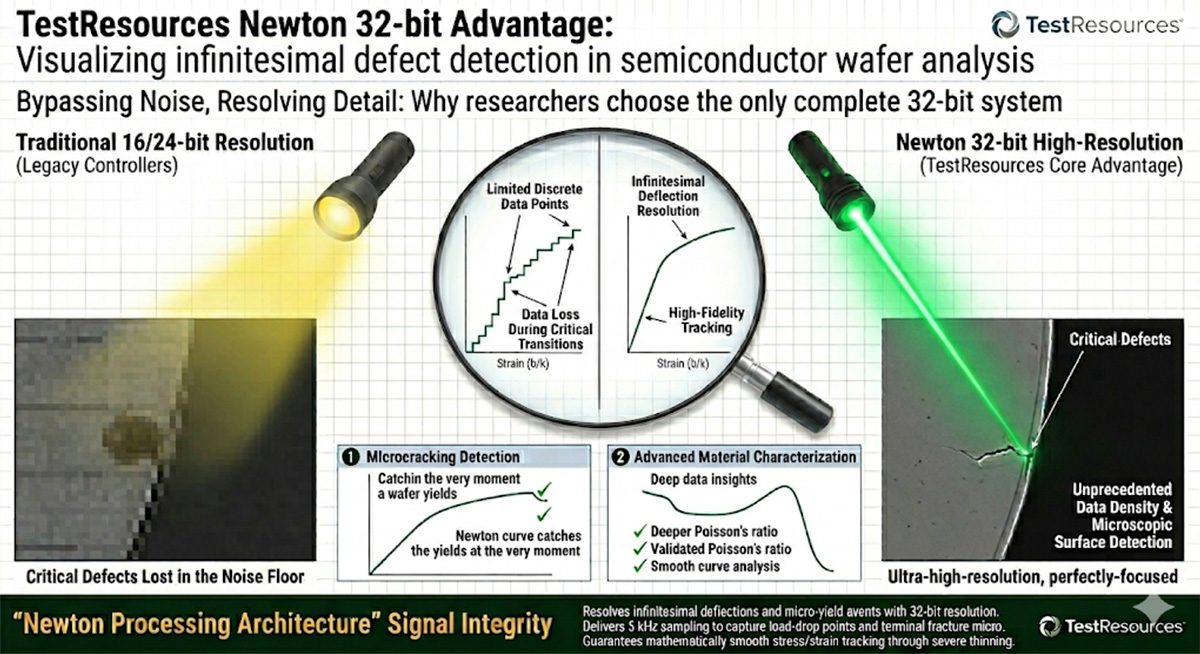
Event Detection: Employs an automated break utility paired with real-time percentage bending monitors. The Newton system triggers an automatic emergency crosshead halt if severe Euler buckling is detected (>10%), shielding the precision-ground clamping blocks from impact damage.
Calculations: Directly calculates Ultimate Compressive Strength, Compressive Modulus of Elasticity (using synchronous back-to-back strain averaging), and real-time Percent Bending validation parameters.
Statistical Output: Generates automated quality control matrices outlining the batch Mean, Standard Deviation (SD), and cross-specimen batch consistency for aerospace compliance validation.
| Load Frame: | TestResources 316-300-1130 Floorstanding Dual Column UTM |
| Control Architecture: | Newton Characterization™ |
| Software Module: | N-STD-D6641 (Supporting Dual-Channel Synchronous Strain Logging) |
| Grips/Fixtures: | G-STD-D6641 (Combined Loading Compression [CLC] Fixture) |
| Strain Measurement: | E-STD-D6641 (TestVE Biaxial Mirror-Non contacting or Epsilon Back-to-Back Extensometry) |