
ASTM C109 is the foundational standard for determining the compressive strength of hydraulic cement mortars using 2-inch (50-mm) cube specimens. It is a critical quality control test utilized globally to verify compliance for infrastructure, structural grouts, and masonry projects. The primary “Measurement Gap” stems from the highly brittle nature of cured cement and the strict regulation of the loading rate. The standard mandates a precise, continuous force-controlled load application. If a technician uses a manual hydraulic valve system, maintaining a smooth, non-shock loading profile is exceptionally difficult. Sudden pacing “surges” or structural frame flexing will introduce artificial energy absorption into the cube, prematurely fracturing the specimen and scattering the true maximum compressive strength data.
To meet the requirements of ASTM C109, MTO recommends a TestResources 600 Series floorstanding frame integrated with Newton Strength™ architecture.
Primary Metric: This method dictates automated, closed-loop force control. The testing platform maintains a specified, uniform loading rate (typically scheduled between 200 to 400 lbs/s [900 to 1800 N/s]) all the way from initial platen seating to ultimate material collapse.
Specimen Geometry: Tests are conducted on standardized 2-inch (50-mm) mortar cubes. The specimen faces must be flat and parallel; any surface crowning, debris, or dimension errors cause point-loading stress concentrations that distort the uniform compressive stress field.
Critical Ratios: Frame and platen rigidity are paramount. Stiff loading platens must be utilized to minimize localized machine bending and ensure an identically distributed axial force across the entire cross-sectional area of the cube.
Problem: Brittle cementitious failures occur abruptly and release massive kinetic energy, producing abrasive dust and extreme structural shock waves that cause signal ringing in standard load sensors and pose a hazard to nearby operators.
Root Cause: Standard quality control indicators lack the fast digital feedback loops and internal buffering required to instantly distinguish actual material fracture from hydraulic pump vibration chatter.
Hardware Solution: MTO recommends a high-capacity floorstanding universal testing system outfitted with a robust upper platen assembly featuring a spherically seated bearing block. This block must be lubricated properly so it can freely tilt and automatically adjust for minor non-parallelism in the molded cube faces, ensuring near-perfect perpendicularity. The lower platen must be ground flat and hardened to resist scratching from abrasive mortar debris. Furthermore, the test zone should be enclosed with a high-impact debris shield to safely contain explosive structural fractures. Real-time logging software should be utilized to track the continuous stress ramp and record peak break values directly into quality database systems.
Processed via the high-resolution Newton digital signal processor providing 4.29 billion discrete calculation levels , delivering mathematically flawless force tracking straight through the high-stiffness failure zone.
Delivers an exceptional 100,000:1 Signal-to-Noise Ratio to filter out dynamic pump noise and electrical harmonics, capturing smooth force curves cleanly.
Commands a rapid 5 kHz data acquisition rate to lock onto the precise microsecond of ultimate cube failure without data clipping.
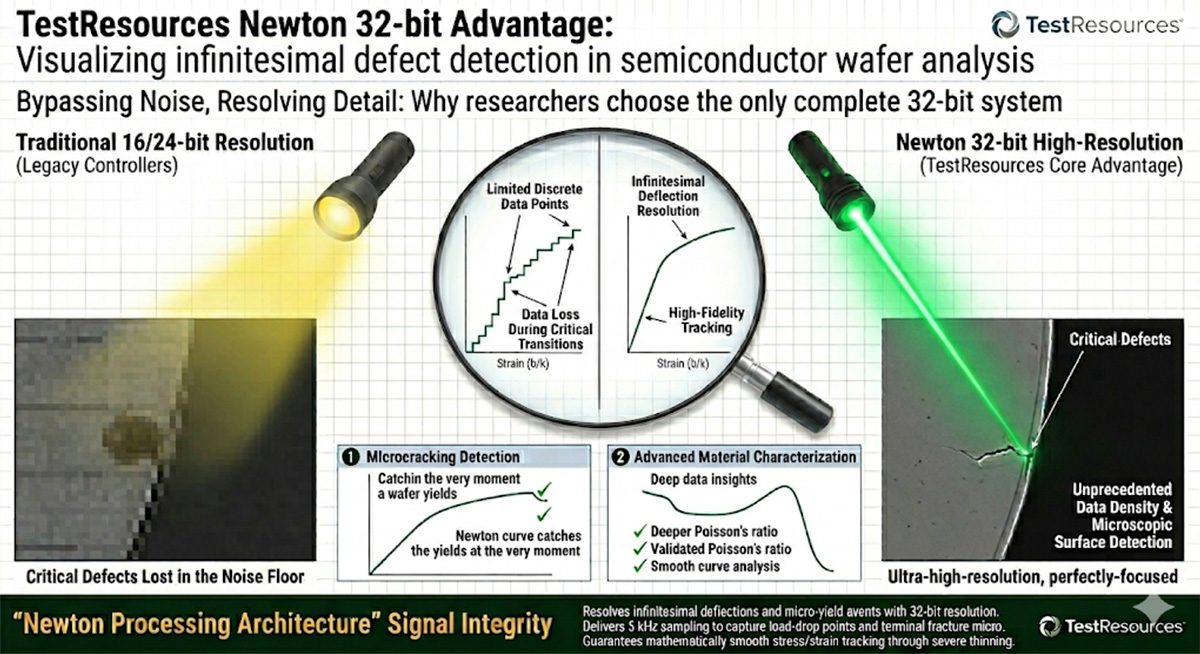
Event Detection: Employs high-response automatic breakaway logic that immediately registers the terminal load drop, halting piston progress to protect the platens from post-test tool clash while cleanly preserving the fractured specimen.
Calculations: Automatically calculates Compressive Strength by dividing the maximum recorded peak force by the precise cross-sectional area of the loaded cube faces.
Statistical Output: Computes integrated multi-specimen batch metrics, summarizing the statistical Mean, Standard Deviation, and material consistency across different cement batches.
| Load Frame: | TestResources 316-300-1130 or 611-600-690 Dual Column UTM |
| Control Architecture: | Newton Strength™ |
| Software Module: | N-ASTM-C109 (Supporting Force-Pace Control & Peak Load Capture) |
| Grips/Fixtures: | G-ASTM-C109 (Hardened Compression Platens with Spherically Seated Upper Block & Safety Cage) |
| Strain Measurement: | Crosshead Displacement is Acceptable for ASTM C109 (Internal Machine Encoder for Piston Stroke) |