
ASTM D575 plays a critical role in establishing the compressive properties—either under a specific structural force loading or down to a specified deflection limit—of vulcanized rubber compounds. The primary “Measurement Gap” stems from the highly viscoelastic, high-deforming profile of elastomers. Defining the exact initial contact “zero point” on soft rubbers is highly ambiguous. Furthermore, as an elastomeric block is compressed, it exhibits severe lateral expansion (“bulging”). If the interface between the specimen faces and the machine platens generates frictional resistance, it triggers the “barrel effect.” This friction induces a triaxial stress state that artificially inflates the recorded compression stress values, hiding the true material performance. Additionally, relying on crosshead travel captures system compliance, distorting early modulus values.
To meet the requirements of ASTM D575, MTO recommends the TestResources 311-10-980 dual-column frame integrated with Newton Characterization™ architecture.
Primary Metric: This configuration enforces a Constant Rate of Extension (CRE) or deflection-rate control mode. The machine drives the compression platens at a Specified, highly uniform quasi-static velocity of 12 mm/min to maintain constant loading sensitivity and prevent dynamic impact artifacts.
Specimen Geometry: Tests are conducted on solid cylindrical discs cut or molded from vulcanized rubber compounds. The loading faces must be flat and parallel to ensure an identically distributed axial force.
Critical Ratios: Specimen dimensions are maintained within strict height-to-diameter boundaries to ensure uniform lateral bulging and suppress localized edge-crushing.
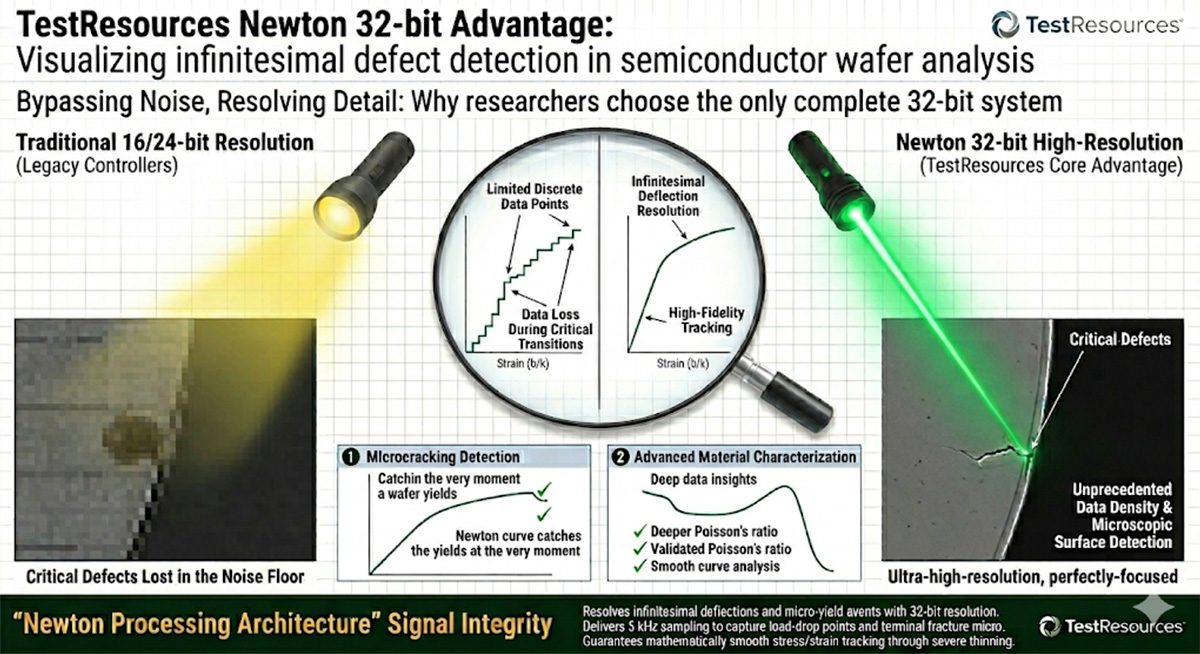
Problem: Elastomeric compression data frequently displays “stair-stepping” signal artifacts and erratic force curves in low-load zones, masking the subtle material hysteresis transitions and corrupting compliance repeatability.
Root Cause: Standard 24-bit data logging units lack the discrete signal resolution needed to isolate minute displacement increments under compliant loads, blending machine frame flex with specimen deformation.
Hardware Solution: MTO recommends employing a dual-column testing platform paired with high-stiffness, precision-ground compression platens. To eliminate the barrel effect paradox, operators must apply a uniform, thin layer of silicone oil or fluorocarbon lubricant to the platen-to-specimen interfaces to allow the rubber to bulge completely freely without frictional interference. To establish a consistent test origin, a strict 1 N preload trigger is executed via software before tracking deflection. Crucially, strain measurement must completely bypass crosshead travel by utilizing a direct-contact E-ASTM-D575 deflectometer or an integrated displacement sensor to measure platen separation directly and remove all systemic frame compliance.
Processed via the Newton digital core yielding 4.29 billion discrete measurement levels (256x greater than legacy 24-bit processors) to trace smooth hyperelastic stress-strain curves continuously without digital steps.
Provides a High-Resolution 100,000:1 ratio to completely silence mechanical frame hum, building vibration, and motor chatter from corrupting fine force data.
Commands a rapid 5 kHz data acquisition rate to map rapid load fluctuations or capture continuous compression cycles flawlessly.
Event Detection: Employs an automated target detection routine. The frame tracks real-time displacement parameters, instantly halting crosshead movement upon reaching the specified deflection limit to prevent accidental platen-to-platen contact.
Calculations: Automatically processes and maps Compressive Stress at specified deflection points, Compressive Deflection under a specified force, and Energy Loss (Hysteresis) loops if dynamic cycling is executed.
Statistical Output: Computes integrated quality control summaries detailing the batch Mean, Standard Deviation (SD), and cross-specimen structural consistency across the tested lot.
| Load Frame: | TestResources 311-10-980 Dual Column UTM |
| Control Architecture: | Newton Characterization™ |
| Software Module: | N-ASTM-D575 (Supporting Preload-Contact Logic & Hysteresis Profiling) |
| Grips/Fixtures: | G-ASTM-D575 (High-Stiffness Precision Ground & Coated Compression Platens) |
| Strain Measurement: | E-ASTM-D575 (Epsilon 3540 Direct Platen-Contact Deflectometer) |