
ASTM D6775 serves as the definitive standard for benchmarking the breaking strength and elongation of structural textile webbing, tape, and braided materials used heavily in safety belts, military gear, and cargo straps. The primary “Measurement Gap” involves managing high clamping forces without inducing localized material failure. If heavy industrial webbing is secured within standard flat wedge grips, the severe jaw line pressure creates a sharp “stress riser” right at the jaw edge, causing the specimen to instantly snap prematurely at the clamp boundary rather than failing in the free gauge length. Furthermore, high-strength synthetic strappings are prone to sliding completely out of manual grips as they stretch and thin under load.
To meet the requirements of ASTM D6775, MTO recommends the TestResources 314-100-1215 dual-column load frame integrated with Newton Strength™ architecture.
Primary Metric: This configuration enforces a Constant Rate of Extension (CRE) control mode. The crosshead drives uniform, quasi-static vertical displacement at a Specified rate of 300 mm/min to maintain steady tension profiles until complete specimen rupture occurs.
Specimen Geometry: Tests are performed on full-width unconstrained segments of textile webbing, woven tape, or heavy braided cords. The materials are highly anisotropic and porous, requiring uniform loading across all structural warp and weft yarns.
Critical Ratios: To ensure friction does the work rather than aggressive mechanical clamping teeth, the specimen must be wrapped properly around the tooling drums, leaving at least one full wrap resting on each cylinder before initializing the test stroke.
Problem: Synthetic webbings and safety straps often experience micro-structural yarn slippage and uneven internal yarn seating during early loading phases, leading to erratic force spikes and unreliable initial elongation tracing.
Root Cause: Standard 24-bit control indicators lack the discrete sampling resolution and real-time buffering required to cleanly separate early yarn-on-yarn friction adjustments from actual global material elongation.
Hardware Solution: MTO recommends the use of specialized G-ASTM-D6775 Split-Capstan or Bollard-style grips. These fixtures gradually dissipate the massive tensile load by wrapping the webbing around a smooth circular drum, successfully moving the ultimate failure zone away from the mechanical clamp line into the specimen’s free length. Clamping force may be driven via Pneumatic Action to ensure continuous clamping pressure that automatically holds the specimen taut as the fabric structure compacts and stretches. Bypassing fragile contacting extensometers, crosshead displacement is standard and fully accepted for tracking textile breaking elongation.
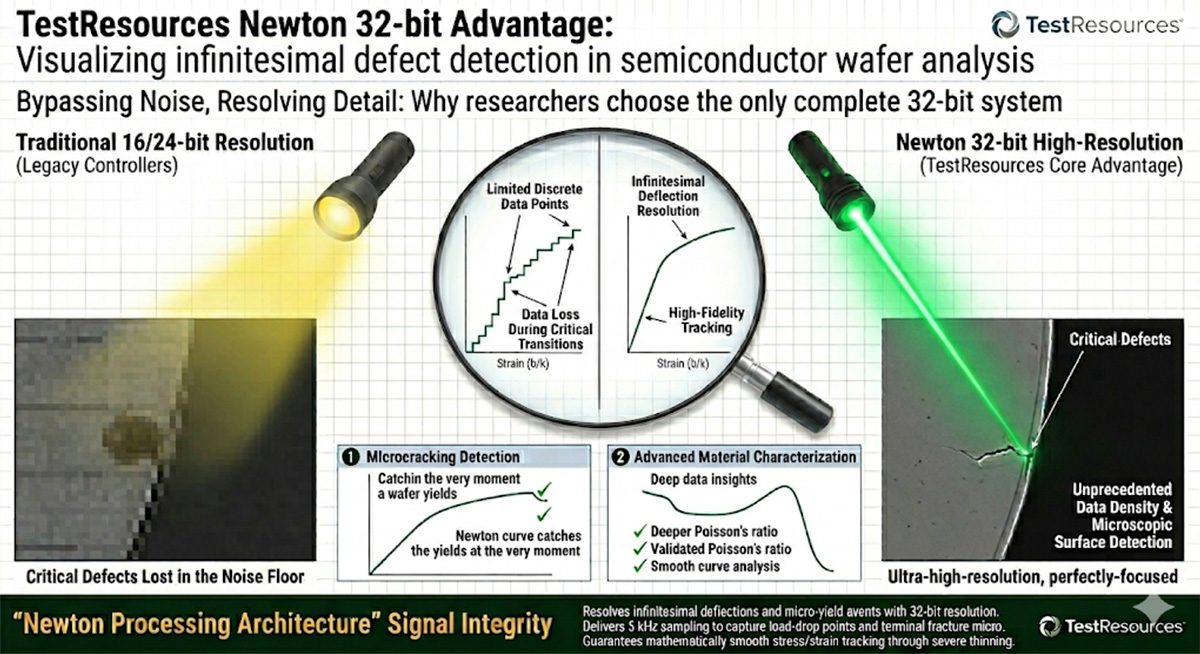
Processed via the Newton digital core to supply 4.29 billion discrete calculation levels (256x greater resolution than legacy 24-bit hardware), tracing smooth, high-fidelity force lines through complex textile structural transitions.
Delivers an exceptional 100,000:1 Signal-to-Noise Ratio to completely filter out mechanical frame rumble and electrical motor chatter, cleanly tracking individual high-tension fiber pops.
Commands a rapid 5 kHz internal digital processing loop to securely log the maximum peak force at the exact millisecond of complete structural breakdown.
Event Detection: Employs an automated break verification utility configured to instantly register terminal load collapse, halting crosshead travel to protect the specialized capstan drums from severe rebounding forces when heavy webbings snap.
Calculations: Automatically processes and isolates Maximum Breaking Strength (Peak Load), Ultimate Elongation percentage, and Total Energy to Break (calculated precisely via the integrated area under the load-displacement curve).
Statistical Output: Generates automated batch matrix summaries documenting the batch Mean, Standard Deviation (SD), and structural material consistency across tested web lots.
| Load Frame: | TestResources 314-100-1215 Floorstanding Dual Column UTM |
| Control Architecture: | Newton Strength™ |
| Software Module: | N-ASTM-D6775 |
| Grips/Fixtures: | G-ASTM-D6775 (Pneumatic Split-Capstan Webbing & Strap Grips) |
| Strain Measurement: | Crosshead Displacement is Acceptable for ASTM D6775 (Internal Machine Encoder for Capstan Jaw Separation) |