Standard Test Methods and Definitions for Mechanical Testing of Steel Products
APP-A370Always use an extensometer rated for high-velocity shocks, and remove it immediately after yield if testing to failure.
Challenge & Testing Gap
High surface hardness and structural scaling on steel coupons cause severe grip slippage and destructive energy release at mechanical failure.
The Solution
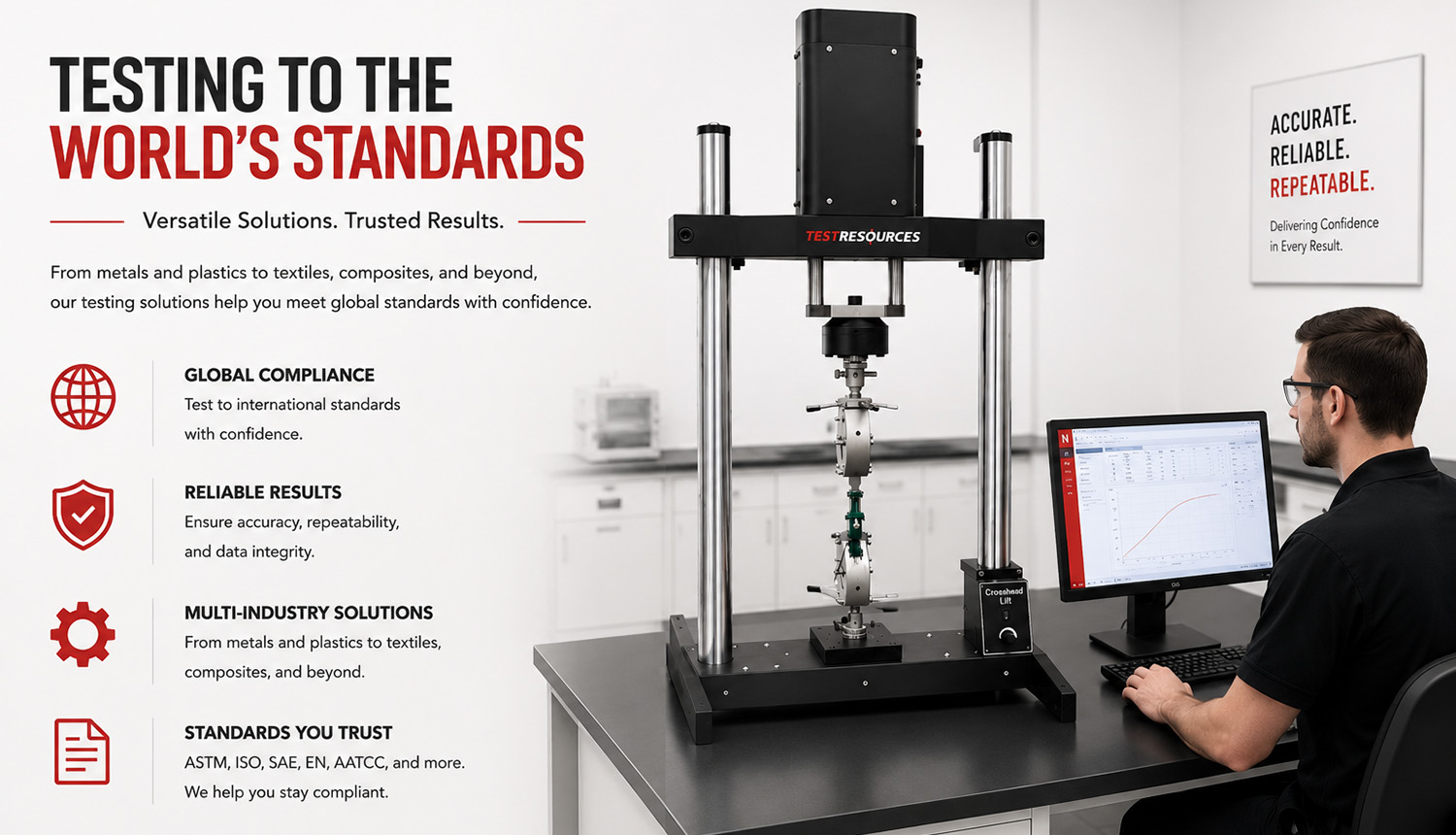
Utilize high-capacity hydraulic wedge grips fitted with hardened serrated file-tooth jaw faces to securely bite the steel matrix.
Mechanics & Specimen Behavior
Primary Mechanics
Axial tensile loading applied at precise stress-rate profiles until ultimate mechanical tensile rupture occurs.
Specimen Details
Machined flat or round cross-section coupon shaped per standard geometry (e.g., plate-type or round 0.500-inch specimen).
Mechanical Ratios & Properties
Gauge length to diameter ratio configured strictly to 4:1 for standard round coupons to maintain mathematical compliance.
Expert Engineering Commentary
Core Problem Identification
Violent specimen recoils causing transient high-frequency shocks that damage standard load cell elements.
Root Cause Analysis
Sudden release of stored elastic energy during the explosive macro-fracture phase of structural steel.
Analysis & Calculation Standards
Event & Failure Detection
Automated 0.2% offset yield mapping or upper/lower yield point tracking via derivative load slope drops.
Required Calculations
Tensile Strength, Yield Strength (Offset), Yield Point, Total Elongation, Reduction of Area, and Modulus of Elasticity.
Statistical Outputs
Batch statistics including mean values, standard deviation, and variance limits across steel production lot samples.
Newton controller with real-time closed-loop strain loop to perfectly track the continuous yield drop.
Additional Commentary
Proper surface preparation isolates the true material yield envelope from systemic friction or grip interface noise.
Ensure all mill scale is ground smooth at the clamping zones to prevent jaw face fouling and subsequent sample slippage.
Common Pitfalls
Using crosshead displacement to calculate elongation instead of a direct-clip extensometer introduces frame compliance errors.