Standard Test Method for In-Plane Shear Response of Polymer Matrix Composite Materials by Tensile Test of a +/-45° Laminate

APP-D3518
Insight:

You must gather both longitudinal and transverse strain simultaneously; in-plane shear strain equals axial strain minus transverse strain.

Challenge & Testing Gap

Large crosshead displacements and extreme scissoring action of the fiber matrix mask the true continuous in-plane shear modulus.

The Solution

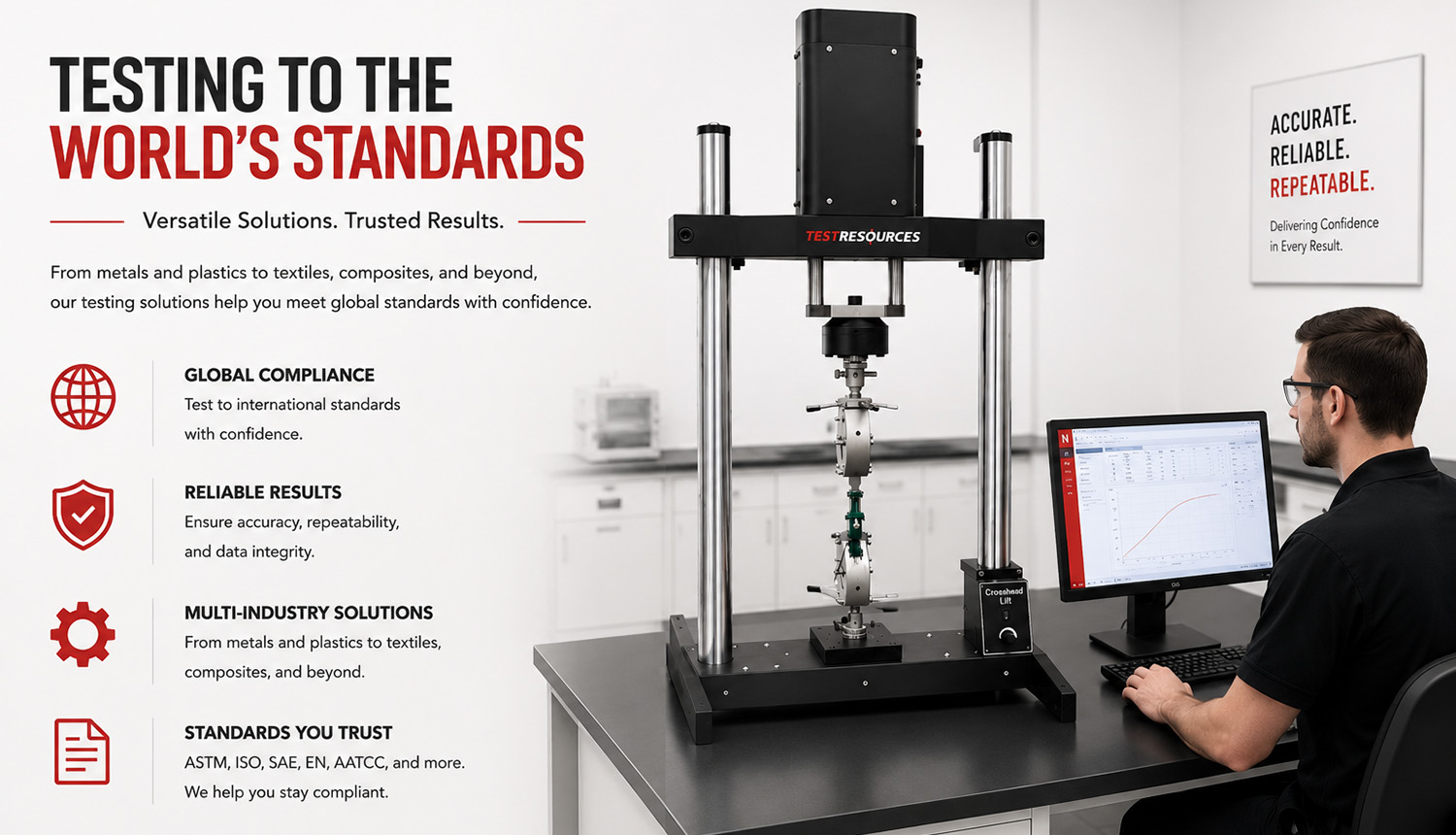
Deploy a heavy-duty dual-column tensile frame equipped with synchronous transverse and axial biaxial extensometers.

Mechanics & Specimen Behavior

Primary Mechanics

Axial tensile pulling of a symmetric angle-ply laminate to induce internal inter-ply matrix shearing deformations.

Specimen Details

Flat rectangular strip coupon with a symmetric +/-45 degree continuous fiber orientation sequence.

Mechanical Ratios & Properties

Standardized dimensions dictate a 250mm overall length, 25mm width, and a continuous cross-ply orientation layer tracking matrix.

Expert Engineering Commentary

Core Problem Identification

Premature matrix cracking near the grip line or extensometer slippage caused by the significant width narrowing of the coupon.

Root Cause Analysis

Ignoring the structural Poisson-effect narrowing during the test, which leads to highly inflated engineering shear values.

Hardware Specific Solutions

Heavy-duty mechanical or hydraulic wedge grips paired with an active dual-axis digital strain mapping matrix.

Analysis & Calculation Standards

Event & Failure Detection

Automated 0.2% offset shear yield logging and continuous strain scanning up to the standard 5% total shear strain limit.

Required Calculations

In-Plane Shear Strength, Secant Shear Modulus, Chord Shear Modulus, Offset Shear Yield Strength, and Maximum Shear Strain.

Statistical Outputs

Lot mean values, standard deviations, coefficient of variation (CV%), and failure mode distributions across 5 cross-ply samples.

The Newton Advantage:

Biaxial data aggregation engines combine orthogonal strain vectors natively at 1000Hz to accurately chart shear deformation.

Additional Commentary

Biaxial extensometers capture the complete true-strain field on the coupon surface, updating the changing area metrics in real time.

Pro Tip:

Stop tracking data for modulus calculations strictly before the material passes 0.4% shear strain to avoid plastic scissoring noise.

Common Pitfalls

Relying on standard single-axis strain formulas, which completely ignores the critical cross-axial contraction mechanics.

Product CTA

Ready to Start Your Project

Name
Name