
ASTM A938 describes the torsion (or twist) testing of metallic wire to evaluate wire ductility under torsional loading. The complex multi-axial stress and strain states generated during wire twisting make this procedure exceptionally sensitive to minor material variations. A major “Measurement Gap” occurs if the wire begins to bend out of axis, distort, or fold over on itself during testing, which completely skews the revolution metrics. Furthermore, if the clamping heads do not remain perfectly coaxial, parasitic bending moments are introduced that compromise the test. To avoid invalid failures, the wire must be gripped firmly without sustaining local surface damage that triggers premature cracking at the jaw interface.
To meet the requirements of ASTM A938, MTO recommends the TestResources 160 Series torsion testing frame integrated with Newton Strength™ control architecture.
Primary Metric: This configuration enforces an angular-velocity control mode, twisting the wire specimen about its longitudinal axis at a constant twisting speed specified by the wire diameter (ranging from 30 to 90 rpm per 100 wire diameters of gauge length) until failure occurs.
Specimen Geometry: Tests are conducted on segments of metallic wire. The wire must be straight prior to testing, with any necessary straightening performed carefully by hand to eliminate surface pits or scratches where maximum shear stress develops.
Critical Ratios: The standard dictates a recommended test length of 8 in. (203 mm) between the clamping heads. To prevent tangential slippage within the jaws, a short section at each wire end (minimum of 0.5 in.) is often bent 90° relative to the wire axis to mechanically lock the sample into the chuck jaws.
Problem: When metallic wires fracture in torsion, they regularly release massive kinetic energy and can rupture into multiple flying fragments due to rapid untwisting following the initial break, creating a serious operator safety hazard.
Root Cause: Standard testing indicators lack integrated high-speed counters or dynamic safety barriers, causing incomplete turn data capture if a fracture occurs too close to the edge of the clamping boundaries.
Hardware Solution: MTO mandates a dedicated torsion platform equipped with chuck jaws that stay coaxial within 10° throughout the twist cycle. One clamping head must be easily displaceable along the wire axis. To prevent the wire from overlaying or folding, a constant axial tension force can be continuously applied via an integrated deadweight pulley or tracking actuator. This ensures the load line stays centered regardless of structural wire lengthening or shortening. A clear, high-impact protective shield or safety enclosure must enclose the test zone to contain flying fragments.
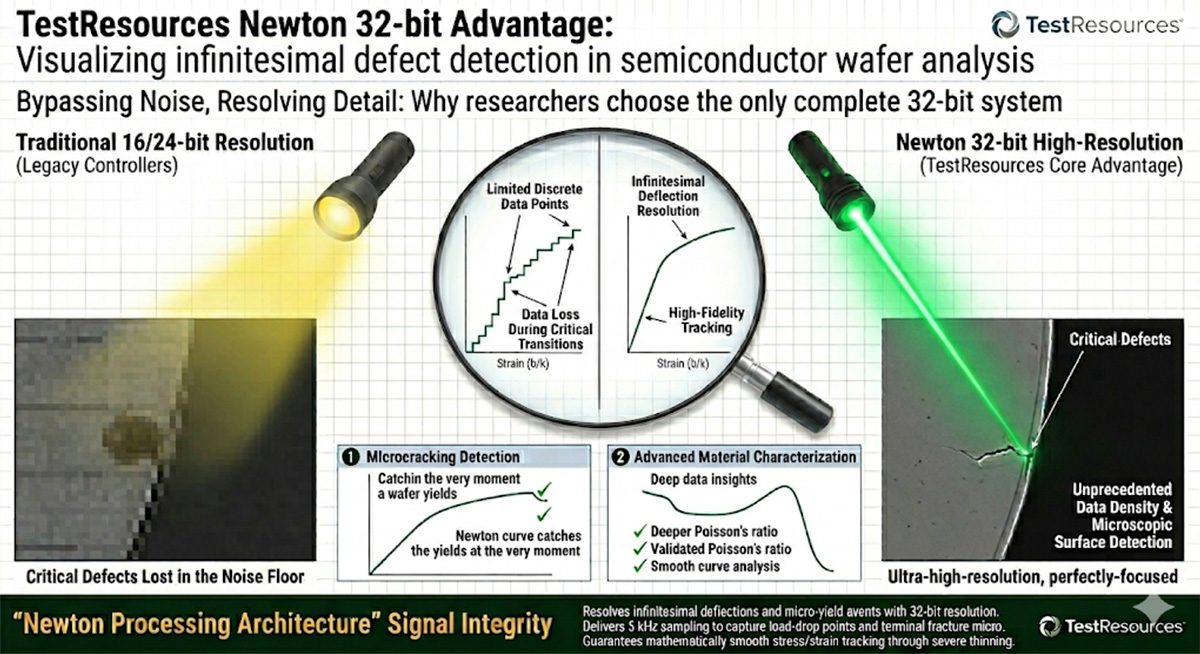
Processed via the Newton digital core to deliver smooth, high-fidelity angular tracking and precise multi-turn capture without data lag or quantization errors.
Operates at a High-Resolution 100,000:1 Signal-to-Noise Ratio to filter out environmental chatter and gear-train motor vibrations.
Event Detection: Employs an automated revolution counter and break tracking utility that logs the final twist value at rupture. If the initial failure breaks within two wire diameters from the clamps, the software flags the test as invalid for immediate repeating.
Calculations: Records the total Number of Turns (revolutions) to failure as the primary ductility index. The system can additionally track the absolute torque required for specimen failure if specified by the user application.
Statistical Output: Generates automated quality control matrices summarizing the batch Mean, Standard Deviation (SD), and material consistency across wire production batches.
| Load Frame: | TestResources 160T2-100-30 Torsion Frame (with Constant Axial Deadweight Tensile System) Note that a higher torque capacity frame may be needed. |
| Control Architecture: | Newton Strength™ |
| Software Module: | N-STD-A938 (With Automated Revolution Counting & Clamp-Boundary Validity Checks) |
| Grips/Fixtures: | G-STD-A938 (Precision Coaxial Chuck Jaws & High-Impact Safety Enclosure Shield) |
| Strain Measurement: | Internal High-Resolution Angular Encoder for Revolution Tracking |