
ASTM D638 is the foundational standard for evaluating the tensile parameters – including tensile strength, ultimate elongation, and modulus of elasticity – essential for verifying the structural integrity of unreinforced and reinforced rigid plastics. Plastics exhibit distinct viscoelasticity, meaning their mechanical properties shift drastically based on test speed, making precise velocity control vital. A major “Measurement Gap” occurs when operators improperly rely on crosshead displacement for modulus calculations. Crosshead travel is notoriously unreliable here due to specimen “seating” and slippage within manual grips, which introduces systemic machine compliance and skews the elastic slope.
To meet the requirements of ASTM D638, MTO recommends the TestResources 312-25-980 dual-column load frame integrated with Newton Characterization™ architecture.
Primary Metric: This method employs a Constant Rate of Extension (CRE) control mode. To remain compliant with the standard’s strict speed constraints, the configuration utilizes an automated “Dual-Speed” approach, running at a Specified speed of 5 mm/min for modulus data collection before adjusting velocities to evaluate ultimate strength traits.
Specimen Geometry: Tests are conducted on injection-molded or machined rigid plastic specimens shaped into standard “Dog-bone” geometries (Types I through V).
Critical Ratios: The system must sync crosshead separation cleanly with localized axial extensometer data to guarantee that the stress/strain distribution through the narrow gauge section remains mathematically smooth.
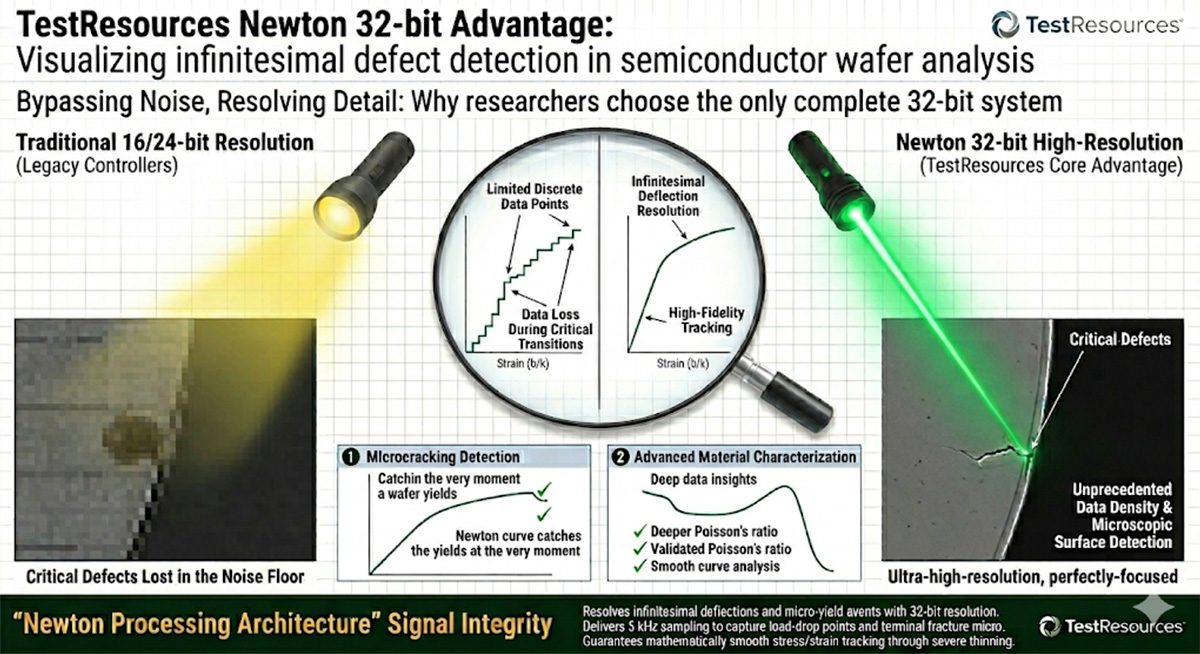
Problem: Stiff or reinforced engineering polymers frequently display “stair-stepping” artifacts during the critical initial linear region, which masks the true transition point to plastic flow and corrupts chord modulus repeatability.
Root Cause: Standard 24-bit controllers lack the discrete resolution needed to track infinitesimal initial displacement changes, generating quantization errors that artificially flatten or ripple the stress-strain slope.
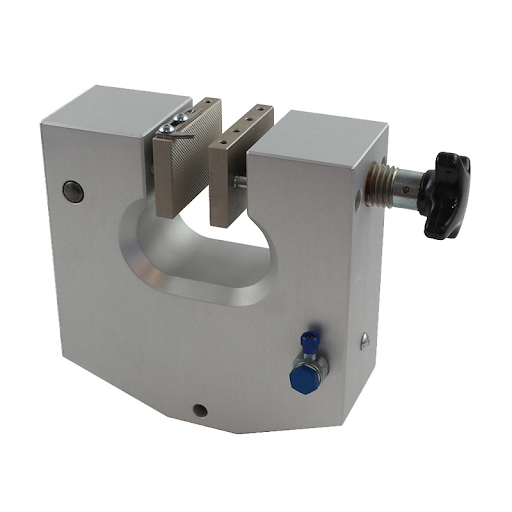
Hardware Solution: MTO mandates the use of Pneumatic Side-Action Grips to supply constant, unyielding clamping pressure that automatically follows the specimen as it necks down and thins out under load. To accurately calculate the Modulus of Elasticity, an external axial clip-on extensometer (such as Epsilon 3542) must be applied directly to the specimen. Always verify that the extensometer’s gauge length matches the narrow section of the dog-bone precisely to prevent capturing the shoulder radius. Alternatively, modern laboratories can utilize TestVE (Non Contacting Extensometry) to track strain seamlessly through the entire failure curve without mechanical knife-edge interference.
Driven by a high-resolution digital processor yielding 4.29 billion discrete measurement levels (256x greater than 24-bit architectures) to track the elastic-to-plastic transition flawlessly without quantization steps.
Delivers an exceptional 100,000 Signal-to-Noise Ratio to silence background electrical chatter and motor-cogging vibration.
Commands a rapid 5 kHz data acquisition rate to catch high-frequency structural break points the millisecond they occur.
Event Detection: Employs an automated break utility that registers quick load drops at material failure and triggers an immediate motor halt to protect the load cell and grip assemblies.
Calculations: Automatically calculates Chord Modulus, Yield Point (zero slope), Tensile Strength at break, and Poisson’s Ratio if a biaxial tracking configuration is selected.
Statistical Output: Generates real-time batch matrices compiling the statistical Mean, Standard Deviation (SD), and material consistency across the entire testing queue.
| Load Frame: | TestResources 312-25-980 Dual Column UTM |
| Control Architecture: | Newton Characterization™ |
| Software Module: | N-ASTM-D638 |
| Grips/Fixtures: | G-ASTM-D638 (Pneumatic Side-Action Grips with constant pressure regulation) |
| Strain Measurement: | E-ASTM-D638 ( Epsilon 3542 Axial Clip-on or TestVE Non Contacting Extensometer) |