
ASTM E8 defines the tension testing of metallic materials in any form, specifically determining critical mechanical properties like yield strength, yield point elongation, ultimate tensile strength, elongation, and reduction of area. The primary “Measurement Gap” involves the precise identification of the yield event (such as the 0.2% Offset Yield or Upper/Lower Yield points), which features a sharp, sudden “kick” in the stress-strain curve. Metals possess exceptional stiffness; consequently, any reliance on crosshead travel for modulus or yield calculation is strictly invalid, as machine frame compliance completely distorts the true elastic-to-plastic transition. Furthermore, high-capacity metal testing involves massive stored elastic energy, creating a violent recoil at break that can easily damage standard sensors and cause specimen slippage.
To meet the requirements of ASTM E8, MTO recommends the TestResources 316-300-1130 floorstanding dual-column load frame integrated with Newton Characterization™ architecture.
Primary Metric: This configuration enforces closed-loop Strain-Rate Control (Method A) to avoid localized data scatter and prevent stress “spikes” during the yield event. The machine dynamically adjusts velocity live based on extensometer feedback within a Specified strain range (typically 0.015 to 0.5 strain/min).
Specimen Geometry: Tests are conducted on standard metallic specimens prepared in round (bar/tube) or flat sheet geometries. Specimen reduced sections must be precision-machined to ensure that the maximum tensile stress remains perfectly localized within the instrumented gauge length.
Critical Ratios: The system must maintain strict alignment tolerances; any structural eccentricity or angular deviation introduces parasitic bending moments that cause specimen “pinging” or invalid failures near the grip faces.
Problem: Stiff metal alloys frequently display “stair-stepping” digital anomalies during the initial elastic slope, which obscures the proportional limit and leads to highly erratic Young’s Modulus and offset yield metrics.
Root Cause: Standard 24-bit data acquisition systems create quantization errors when trying to capture microstrain increments under high-force loads, blending machine structural “squish” with actual specimen elongation.
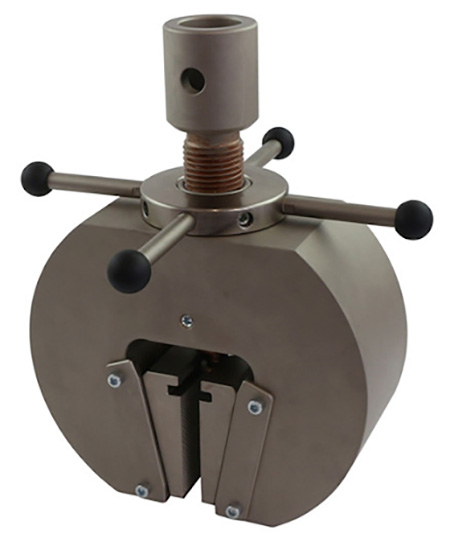
Hardware Solution: MTO mandates the use of High-Capacity Hydraulic or Pneumatic Wedge Grips engineered to handle high-energy recoil while maintaining constant clamping contact. To safely measure true elongation, an external axial clip-on extensometer (Epsilon 3542) must be applied directly to the specimen gauge area. For testing high-strength alloys or titanium, the extensometer must be equipped with hardened Tungsten Carbide knife edges to prevent micro-slipping. Alternatively, modern laboratories can utilize TestVE (Video Extensometry) to seamlessly track strain and necking behavior through ultimate fracture without any risk of mechanical recoil damage.
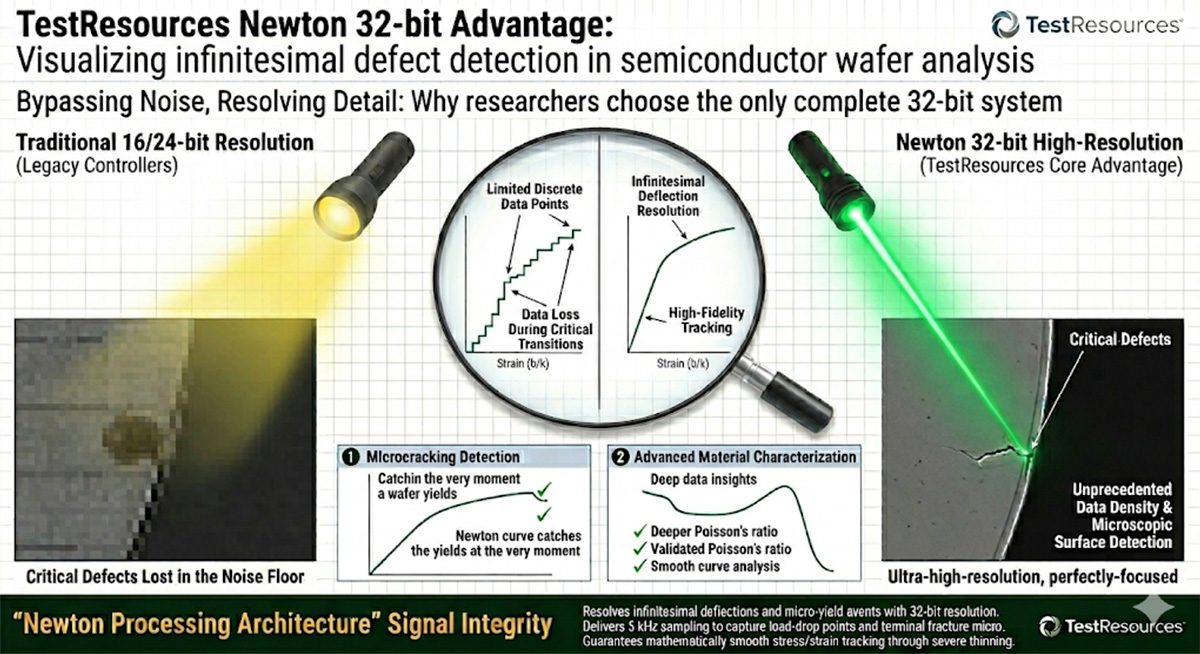
Driven by a high-resolution processor delivering 4.29 billion discrete measurement levels (256x greater resolution than 24-bit architectures) to capture the elastic-to-plastic transition with extreme fidelity.
Delivers a High-Resolution 100,000:1 Signal-to-Noise Ratio to completely silence structural motor vibration and background electrical chatter.
Commands a rapid 5 kHz data acquisition loop to continuously log data points and capture sudden material transitions at the microsecond level.
Event Detection: Employs specialized automated break detection utilities that monitor real-time load decay, halting the frame within a fraction of a millisecond post-fracture to shield the load string from structural shock.
Calculations: Directly resolves Upper and Lower Yield Strength, Yield Point Elongation (YPE), Ultimate Tensile Strength (UTS), Plastic Strain Ratio (r-value), and Strain-Hardening Exponent (n-value).
Statistical Output: Computes integrated batch analytics detailing the automated Mean, Standard Deviation (SD), and cross-specimen batch consistency for strict quality control verification.
| Load Frame: | TestResources 316-300-1130 Floorstanding Dual Column UTM |
| Control Architecture: | Newton Characterization™ |
| Software Module: | N-ASTM-E8 |
| Grips/Fixtures: | G-ASTM-E8 (High-Capacity Robust Wedge Grips) |
| Strain Measurement: | E-ASTM-E8 (Epsilon 3542 Class 0.5 Extensometer or TestVE Non Contacting Extensometry) |