Standard Test Methods for Rigid Sheet and Plate Materials Used for Electrical Insulation

APP-D229
Insight:

Always track and document sheet extrusion direction; test samples in both longitudinal and transverse axes to chart directional variation.

Challenge & Testing Gap

Extraneous frame compliance and localized anvil crushing introduce high deformation errors into high-modulus insulating laminates.

The Solution

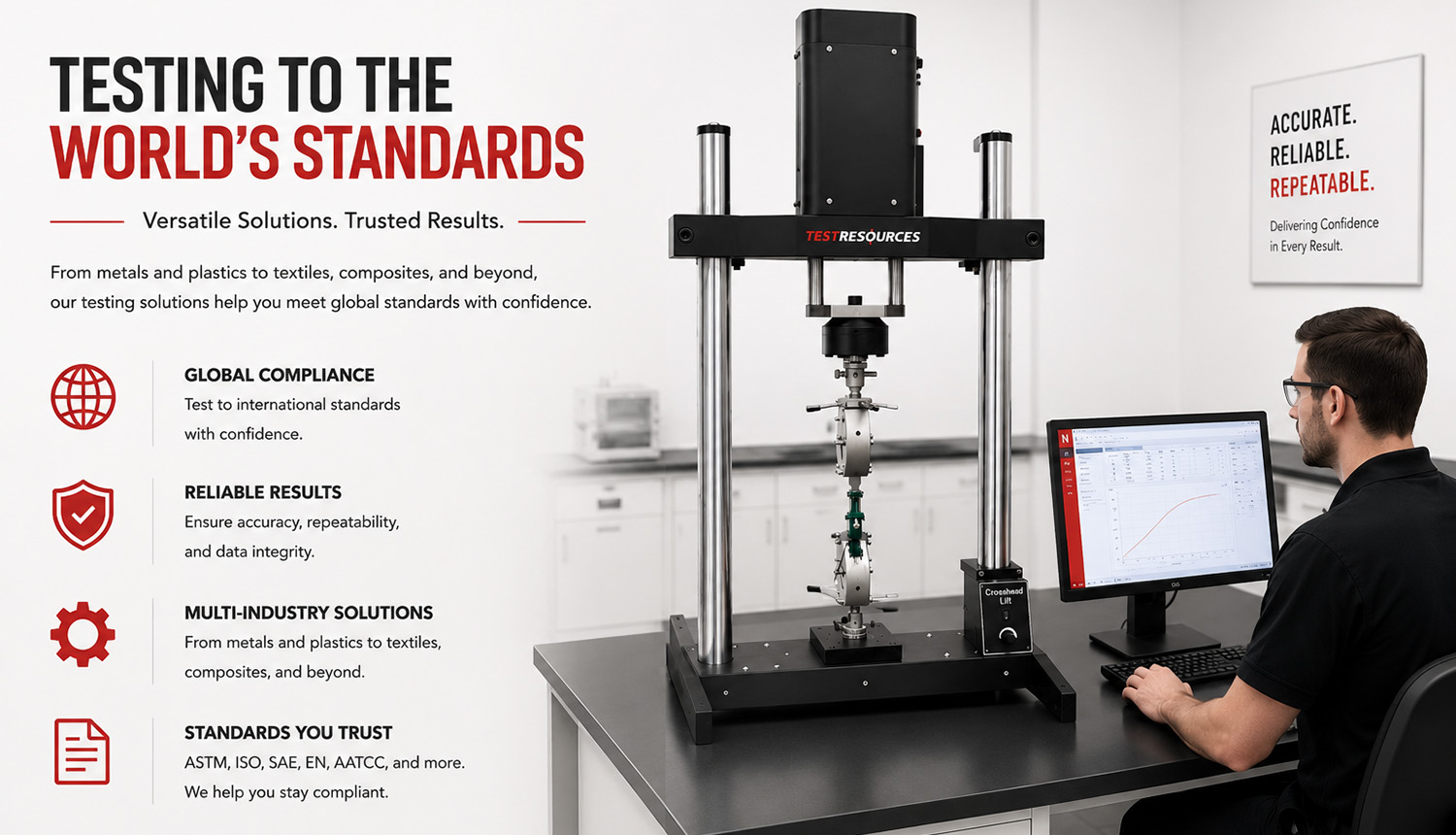
Integrate heavy-duty dual-column frames with high-accuracy direct-contact deflectometers and hardened alloy fixtures.

Mechanics & Specimen Behavior

Primary Mechanics

Multi-purpose testing matrix comprising tensile loading, three-point flexural bending, and axial compression profiles on flat plates.

Specimen Details

Varies widely by sub-test; includes flat rectangular bars for flexure and standard dumbbell coupons for tensile evaluation.

Mechanical Ratios & Properties

Flexural profiles utilize a 16:1 span-to-depth ratio baseline to eliminate interlaminar horizontal shear anomalies during down-strokes.

Expert Engineering Commentary

Core Problem Identification

Early compression fracturing or crushing at the loading point due to unpolished, narrow-radius loading anvils.

Root Cause Analysis

Failing to account for laminate structural anisotropy when cutting specimens from sheet stock, leading to highly erratic modulus trends.

Hardware Specific Solutions

Hardened steel 3-point bend fixtures combined with high-pressure wedge grips and direct-contact LVDT strain assemblies.

Analysis & Calculation Standards

Event & Failure Detection

Automated offset yield point tracking (0.2%) combined with sharp-drop break detection limits.

Required Calculations

Tensile Strength, Flexural Strength, Flexural Modulus, Compressive Strength, and Dissipation Factor metrics where applicable.

Statistical Outputs

Comprehensive batch statistics including mean parameters, standard deviation tracking, and lot validation summaries.

The Newton Advantage:

Synchronous multi-channel data acquisition matrix registers force and direct deformation variables simultaneously up to 1000Hz.

Additional Commentary

Dual-column structural frames deliver the high mechanical rigidity required to evaluate ultra-dense composite insulation laminates.

Pro Tip:

Use a direct deflectometer rather than crosshead displacement for flex testing to bypass inherent frame deflection anomalies.

Common Pitfalls

Mixing up machine-direction and cross-direction specimens within the same statistical testing batch.

Product CTA

Ready to Start Your Project

Name
Name