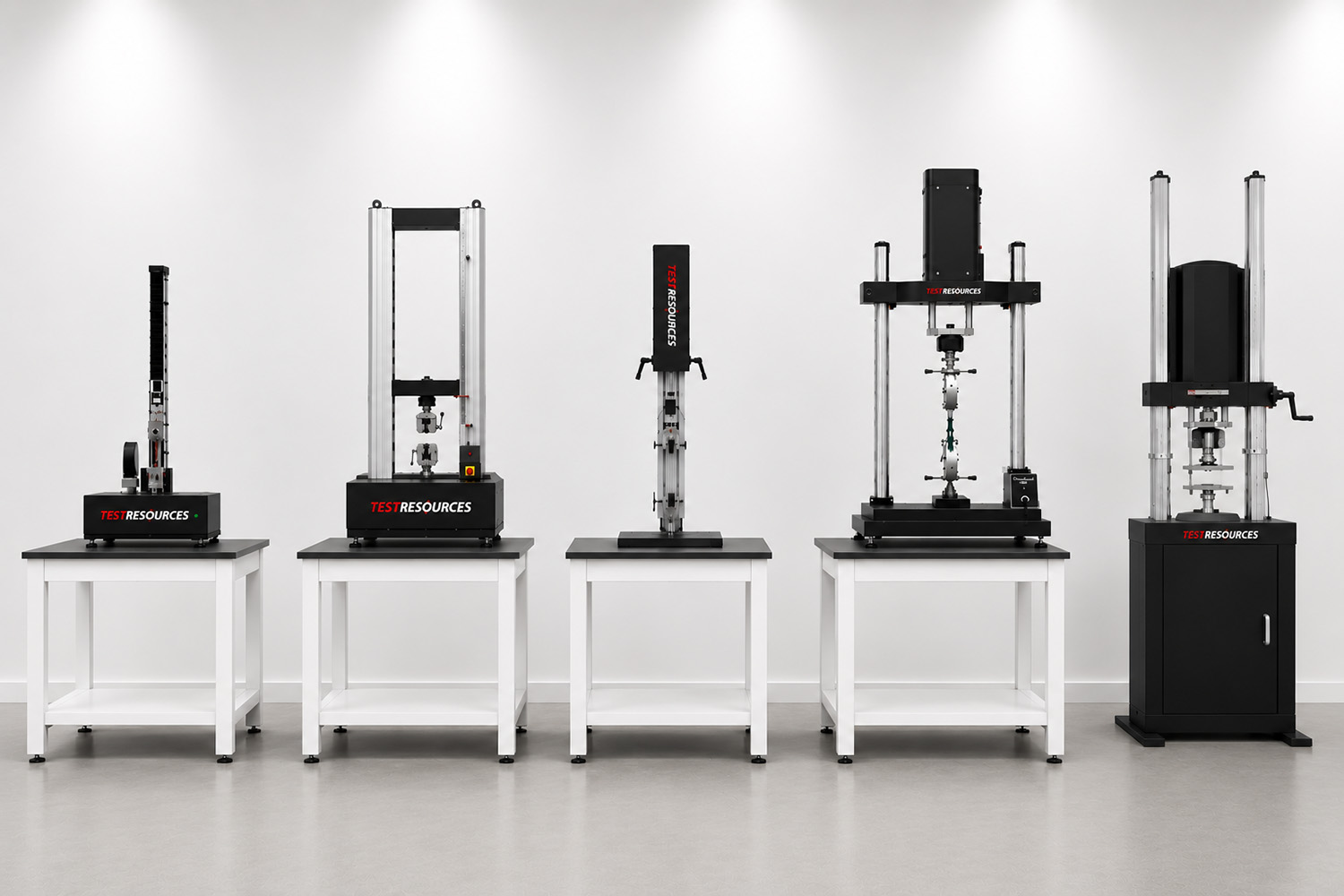
A clean servoelectric dual-column benchtop system delivering a 2.2 kN capacity and 150 mm travel window. Capable of high-frequency cycling up to 15 Hz, it eliminates fluid leak risks during continuous material endurance profiling.
The Newton Fatigue Platform is designed for materials testing laboratories, aerospace engineering teams, and biomedical researchers who require precise long-term durability analysis. Built to support cyclic, constant-amplitude, and multi-block fatigue testing, it transforms conventional test frames into advanced dynamic testing systems capable of delivering consistent, high-integrity results. Whether your applications involve generating S-N curves, evaluating fracture toughness, or monitoring component degradation over millions of load cycles, Newton Fatigue provides the stability, signal accuracy, and continuous performance needed to track crack initiation and propagation with confidence.
These servoelectric models provide a clean, oil-free alternative to hydraulic systems, capable of high-frequency cycling (up to 15 Hz) for component life-cycle and fatigue analysis.
Expert Commentary
For users moving from static to dynamic testing, the 800-series frames provide a seamless bridge. They handle standard tension/compression tasks while allowing for complex waveform generation.
Pro Tip
LOAD MATCHING: Select high-stiffness micro load cells calibrated for sub-kilo zones when capturing initial fatigue lifecycle degradation events.

Applications & Expert Insights
Expert Nugget
These servoelectric models provide a clean, oil-free alternative to hydraulic systems, capable of high-frequency cycling (up to 15 Hz) for component life-cycle and fatigue analysis.
Expert Commentary
For users moving from static to dynamic testing, the 800-series frames provide a seamless bridge. They handle standard tension/compression tasks while allowing for complex waveform generation.
Pro Tip
LOAD MATCHING: Select high-stiffness micro load cells calibrated for sub-kilo zones when capturing initial fatigue lifecycle degradation events.