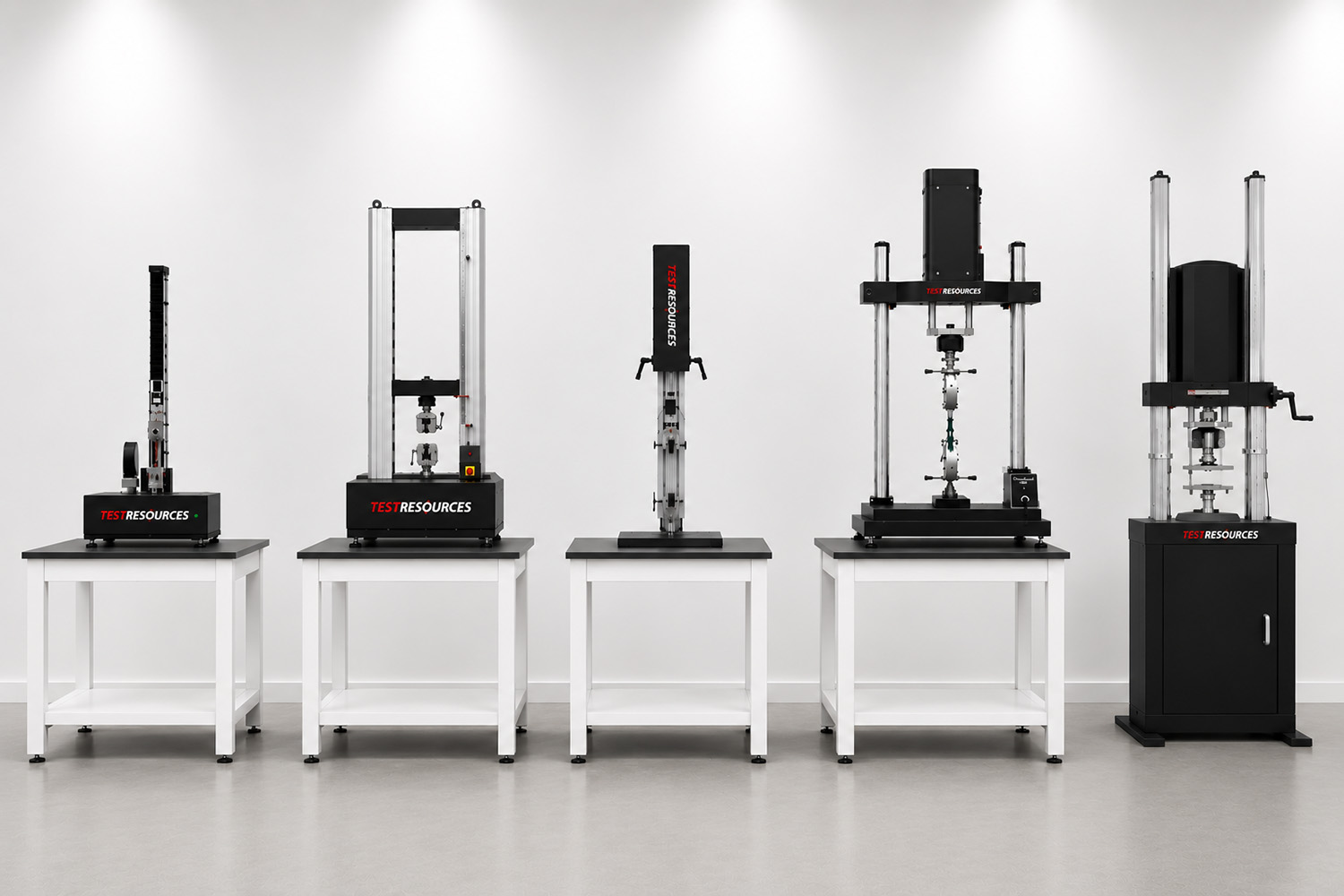
A highly versatile dual-column servoelectric benchtop platform providing a 15.5 kN dynamic capacity and 200 mm travel. The actuator design delivers precise high-frequency velocity response profiles across complete multi-waveform routines.
The Newton Fatigue Platform is designed for materials testing laboratories, aerospace engineering teams, and biomedical researchers who require precise long-term durability analysis. Built to support cyclic, constant-amplitude, and multi-block fatigue testing, it transforms conventional test frames into advanced dynamic testing systems capable of delivering consistent, high-integrity results. Whether your applications involve generating S-N curves, evaluating fracture toughness, or monitoring component degradation over millions of load cycles, Newton Fatigue provides the stability, signal accuracy, and continuous performance needed to track crack initiation and propagation with confidence.
Advanced Fatigue Research: High-frequency (15 Hz) servoelectric dual-column frames. Bridges the gap between static characterization and complex waveform fatigue.
Expert Commentary
High versatility servoelectric actuator design provides the precise velocity response profiles necessary for transition phase materials research.
Pro Tip
THERMAL DRIFT DEDUCTION: Allow electronics to reach steady-state warmth parameters before executing primary high-cycle material logging runs.
Machine Hardware
Machine Type:
Dynamic
Test Type:
Compression, Tension
Drive Type:
Servoelectric
Applications:
High Versatility Fatigue Verification, Multi-Waveform Component Evaluation, Transition Phase Materials Research

Applications & Expert Insights
Expert Nugget
Advanced Fatigue Research: High-frequency (15 Hz) servoelectric dual-column frames. Bridges the gap between static characterization and complex waveform fatigue.
Expert Commentary
High versatility servoelectric actuator design provides the precise velocity response profiles necessary for transition phase materials research.
Pro Tip
THERMAL DRIFT DEDUCTION: Allow electronics to reach steady-state warmth parameters before executing primary high-cycle material logging runs.