
ASTM A370 is the “Master” metals standard that bridges the gap between general tension testing (ASTM E8) and specific steel product specifications. This critical umbrella standard governs the mechanical evaluation including tensile and bend testing of high-strength steel bars, tubes, and pipeline alloys. The primary “Measurement Gap” involves managing the massive energy release and violent structural recoil generated when high-capacity steel products snap. Furthermore, compliance requires precise control over yield point detection. Capturing the high-frequency data necessary to distinguish between upper and lower yield points requires rapid data acquisition loops to prevent machine momentum from obscuring the material’s actual elastic-to-plastic transition.
To meet the requirements of ASTM A370, MTO recommends the TestResources 611-600-690 dual-column frame integrated with Newton Characterization™ architecture.
Primary Metric: This configuration enforces closed-loop Strain-Rate Control (Method A) during the yield transition. The system monitors live feedback to precisely control the loading speed, as exceeding speed limits during the yield transition can artificially inflate yield strength values.
Specimen Geometry: Hardware adapters and crosshead setups must be versatile enough to switch seamlessly between 12.5mm (0.5 in.) round specimens, full-section plate specimens, and structural bar or tube geometries.
Critical Ratios: The frame must be paired with an exceptionally rigid load string to guarantee that the high-capacity axial forces stay perfectly concentric, eliminating parasitic bending moments that would invalidate the tensile profile.
Problem: Steel yield transitions and elongation parameters are frequently corrupted by “stair-stepping” signal artifacts and electrical chatter, leading to misidentified or smoothed-over upper and lower yield points.
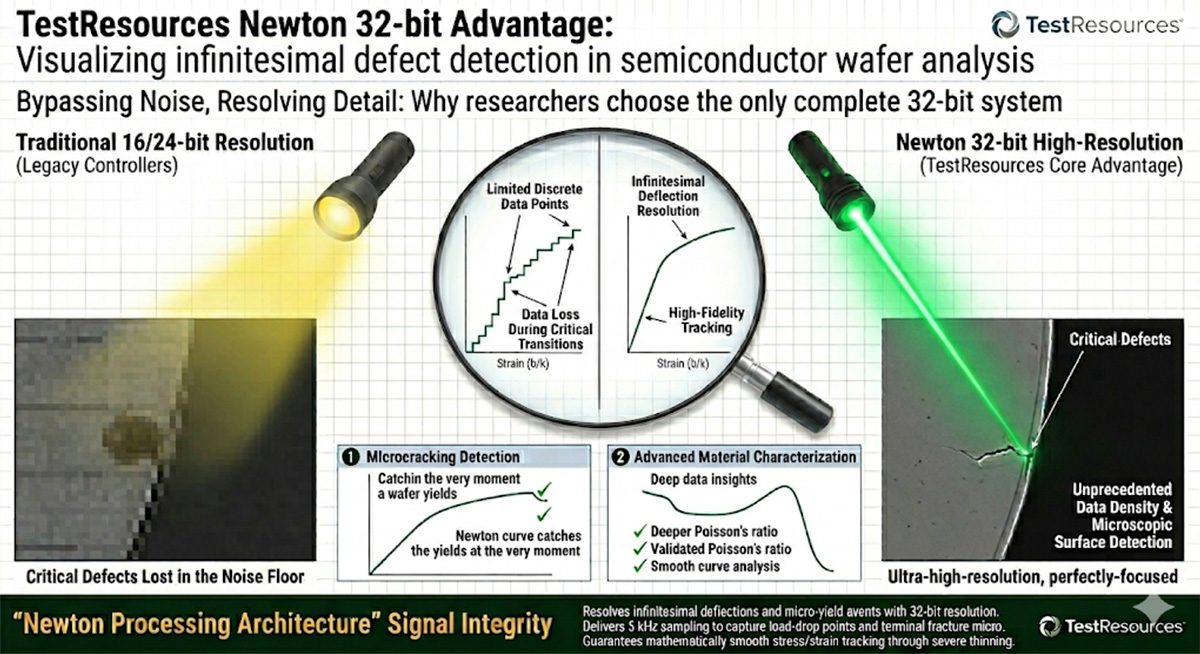
Root Cause: Standard 24-bit data logging units lack the discrete digital resolution needed to capture microstrain steps under high-force loads, blending the machine frame’s structural compliance with the specimen’s true flow behavior.
Hardware Solution: MTO recommends the use of a TestResources 611 or 612 servohydraulic testing platform equipped with a heavy-duty debris shield to isolate the testing zone and safely manage high energy release at failure. Grip systems must utilize robust, integrated wedge-action jaws capable of biting securely into hardened steel scaling without inducing micro-slippage or surface pinches. For accurate strain tracking through the yield event, a Class 0.5 direct-contact extensometer (Epsilon 3542) outfitted with hardened Tungsten Carbide knife edges should be utilized. Alternatively, TestVE (Non Contacting Extensometry) can be deployed to safely track necking and ultimate elongation without risk of sensor damage during violent specimen recoil.
Driven by a high-resolution digital signal processor providing 4.29 billion discrete measurement levels (256x greater than legacy 24-bit processors) to trace the steel elastic-to-plastic transition flawlessly.
Delivers an exceptional 100,000 Signal-to-Noise Ratio to filter out environmental chatter and hydraulic pump harmonics, uncovering the true material profile.
Commands a rapid 5 kHz data acquisition loop to capture sudden load drops and trace microsecond-long material transitions precisely.
Event Detection: Employs automated high-speed break verification logic that stops crosshead travel within a fraction of a millisecond post-fracture, protecting the integrated wedge grips from terminal impact shock.
Calculations: Automatically processes and isolates Upper/Lower Yield Strength, Extension Under Load (EUL), 0.2% Offset Yield, Ultimate Tensile Strength (UTS), Total Elongation, and area reduction percentages.
Statistical Output: Generates real-time quality control matrices compiling the statistical Mean, Standard Deviation (SD), and cross-specimen batch consistency for structural steel compliance.
| Load Frame: | TestResources 611-600-690 Dual Column Servohydraulic UTM |
| Control Architecture: | Newton Characterization™ |
| Software Module: | N-ASTM-A370 |
| Grips/Fixtures: | G-ASTM-A370-S14 (Integrated Wedge Action Jaws & Heavy-Duty Debris Shield) |
| Strain Measurement: | E-ASTM-A370 (Epsilon 3542 Class 0.5 Extensometer or TestVE Non Contacting Extensometry) |