
ASTM C39 is the industry-wide benchmark for evaluating the compressive strength of cylindrical concrete specimens, molded cylinders, and drilled cores. It serves as a vital indicator for concrete mix verification, placement quality control, and legal specification compliance across all major infrastructure programs. The primary “Measurement Gap” involves the strict regulation of the loading rate. Technicians working on manual compression frames struggle to eliminate human error and variability when trying to manipulate a consistent hydraulic valve envelope. Fluctuations or sudden shocks during load introduction can cause premature structural cracking, artificially altering the recorded maximum stress. Furthermore, any non-parallelism or improper axial placement within the machine daylight creates eccentric loading, skewing the uniform triaxial stress field and yielding non-compliant fracture profiles.
To meet the requirements of ASTM C39, MTO recommends the TestResources ASTM C39 Concrete Compression System integrated with Newton Strength™ architecture.
Primary Metric: This method dictates force-controlled axial compression loading. The TestResources 639-2000 operates under an automated closed-loop servovalve, maintaining a specified linear loading rate (typically between 28 to 42 psi/s or 0.15 to 0.35 MPa/s) all the way to complete specimen collapse.
Specimen Geometry: Tests are conducted on standardized concrete cylinders—commonly 150 mm x 300 mm (6 in. x 12 in.) or 100 mm x 200 mm (4 in. x 8 in.) shapes—or drilled structural cores. Cylinder end surfaces must be prepared via rigorous grinding machines or specialized pad caps to maintain a plane elevation difference under 0.002 inches.
Critical Ratios: The system relies on a high-stiffness, compression-only load frame configuration. Stiff, parallel platens are essential to prevent structural frame deflection or tilting from introducing local stress concentrations across the cylinder faces.
Problem: Brittle concrete failures release massive kinetic energy, creating significant abrasive dust and high-frequency structural shock that can quickly corrupt data lines and degrade the accuracy of standard load sensors.
Root Cause: Standard compression indicators lack the real-time feedback loops required to smoothly transition from initial specimen seating to ultimate break verification. Manual pace tracking often fails to isolate real material load behavior from systemic hydraulic valve chatter.
Hardware Solution: MTO mandates an automated concrete compression system with an oversized frame opening to allow effortless specimen loading. The lower platen must be robust and scribed with concentric rings to facilitate perfect center alignment. The upper loading assembly must incorporate a spherically seated bearing block to automatically compensate for minor specimen non-parallelism, ensuring the load line stays perfectly perpendicular to the specimen plane. To isolate frame settling, the connected system should feature real-time load and stress monitoring software to log the exact fracture patterns and track batch trends automatically.
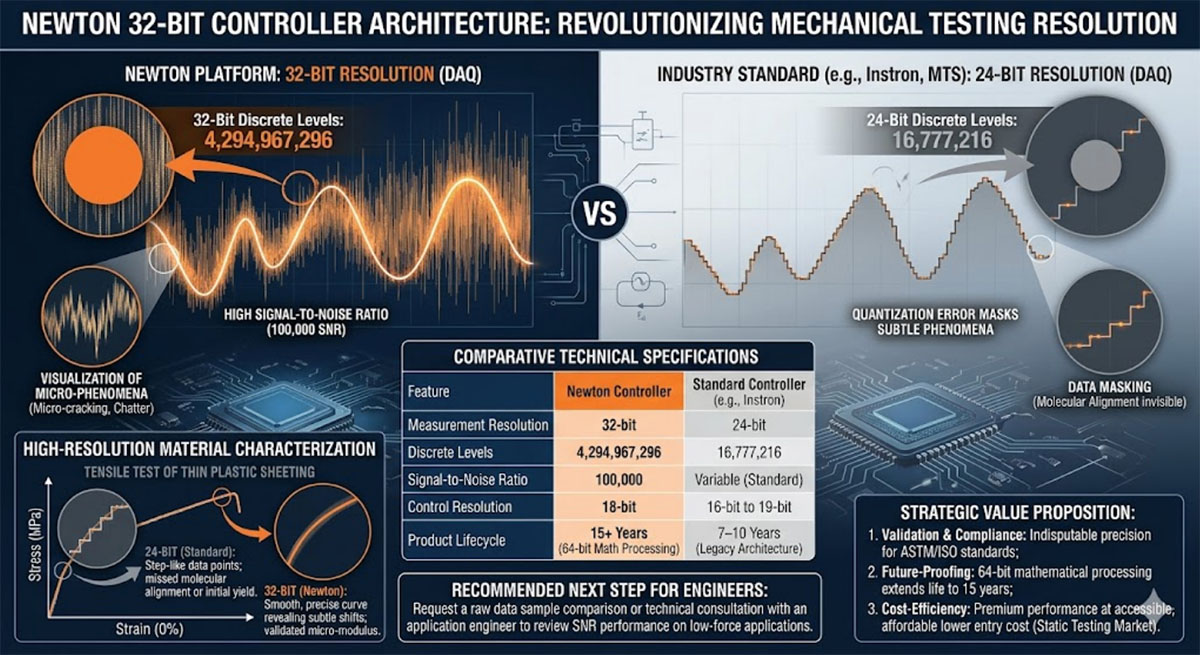
Processed via the high-resolution Newton digital signal processor providing 4.29 billion discrete calculation levels, enabling mathematically flawless force tracking from initial contact to the structural failure point.
Delivers an exceptional 100,000:1 Signal-to-Noise Ratio to completely filter out hydraulic pump vibrations and electrical chatter, uncovering true concrete density transitions.
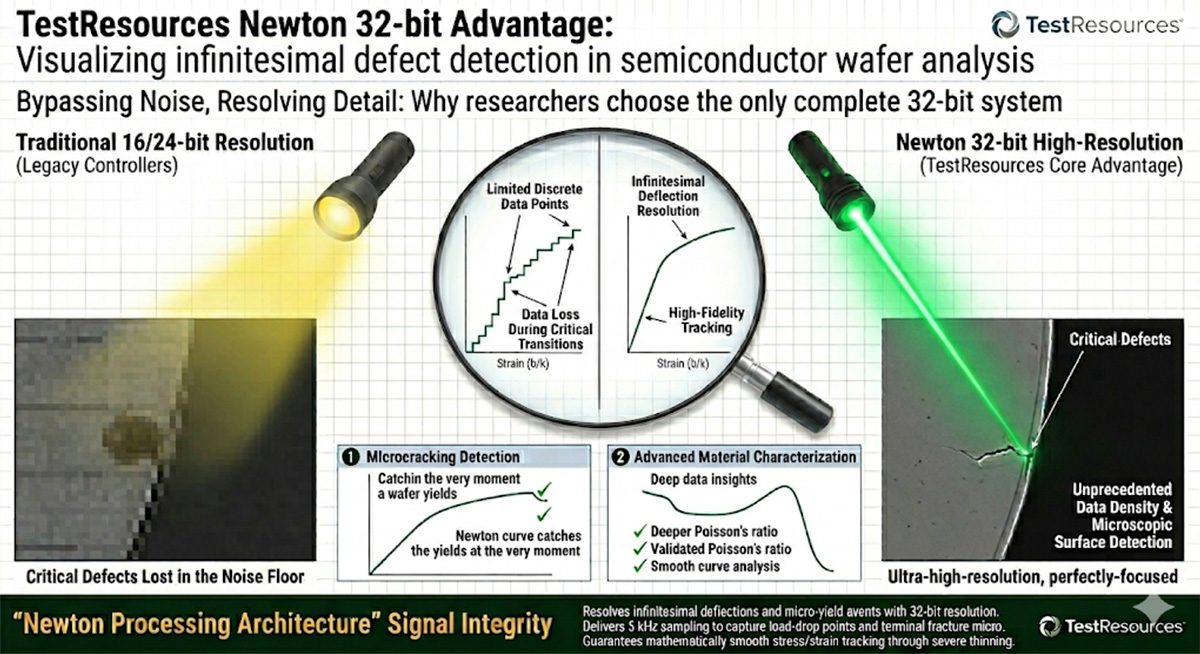
Event Detection: Employs high-response automatic break detection logic that instantly registers the ultimate load drop, protecting components from terminal impact damage while logging the precise fracture classification.
Calculations: Automatically calculates Compressive Strength by dividing the maximum compressive load by the average cross-sectional area of the concrete cylinder.
Statistical Output: Generates automated multi-cylinder batch metrics, summarizing the statistical Mean, Standard Deviation (SD), and acceptance parameters for direct transfer to LIMS packages.
| Load Frame: | TestResources 639H-2000 Integrated Concrete Compression Frame |
| Control Architecture: | Newton Strength™ |
| Software Module: | N-ASTM-C39 (With Real-Time Load/Stress Monitoring & Break Type Logging) |
| Grips/Fixtures: | G-ASTM-C39 (Spherically Seated Upper Platen & Fixed Lower Platen with Centering Rings) |
| Strain Measurement: | Crosshead Displacement Acceptable for ASTM C39 (Encoder for Piston Stroke) |