
ASTM D3039 plays a critical role in establishing the ultimate tensile strength, strain, and Poisson’s ratio of high-modulus, anisotropic fiber-reinforced polymer matrix composites. However, a severe “Measurement Gap” exists due to the exceptional stiffness and low strain-to-failure profile of these advanced materials. Relying on crosshead displacement is completely invalid as it captures the crushing of the specimen tabs within the wedge grips rather than true material elongation. Furthermore, composite materials store massive energy and shatter upon failure. Any minor load string eccentricity introduces a bending moment that creates non-uniform strain fields, making the test statistically invalid if percent bending exceeds 10%.
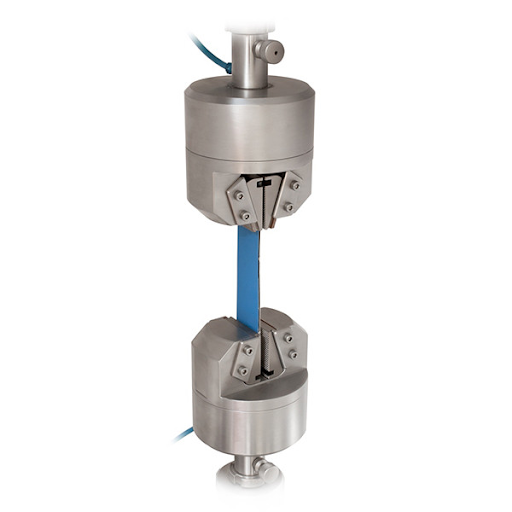
To meet the requirements of ASTM D3039, MTO recommends the TestResources 316-300-1130 dual-column floorstanding frame integrated with Newton Characterization™ architecture.
Primary Metric: This configuration utilizes an advanced closed-loop strain-rate control mode (Method A), automatically adjusting crosshead velocity live based on extensometer feedback to maintain a highly stable, uniform strain rate.
Specimen Geometry: Tests are executed on straight-sided rectangular composite strips, which are typically equipped with bonded, tapered reinforcement tabs (such as G10) at the gripped ends to suppress catastrophic jaw-crushing or premature edge-delamination.
Critical Ratios: Perfect physical centering of the composite tabs within the load string is mandatory; a tab bonded even 0.5 mm off-center creates an eccentric load path that a single-sided sensor cannot correct.
Problem: Brittle carbon or glass fiber laminates are highly vulnerable to localized surface indentation and “stair-stepping” signal artifacts when capturing the minute chord modulus and Poisson’s ratio strain windows. High speeds must be avoided as they trigger explosive failures that destroy the specimen ends.
Root Cause: Standard 24-bit data logging units create severe quantization or “stepping” errors when attempting to resolve microstrain increments (between 0.0005 and 0.0025 strain points) without introducing mechanical loop lag.
Hardware Solution: MTO recommends deploying High-Capacity Hydraulic or Pneumatic Wedge Grips engineered to exert deep, unyielding clamping pressure to eradicate micro-slippage during peak load transitions. To eliminate localized knife-edge scoring or surface-prep defects, non-contacting TestVE (Video & Optical) configured for multi-point tracking across the gauge length is highly recommended. If a traditional clip-on extensometer partnering firm model is utilized, a Class 0.5 or Class 1 biaxial system must be paired with back-to-back strain monitoring to verify that percent bending remains strictly under the 10% legal verification threshold.
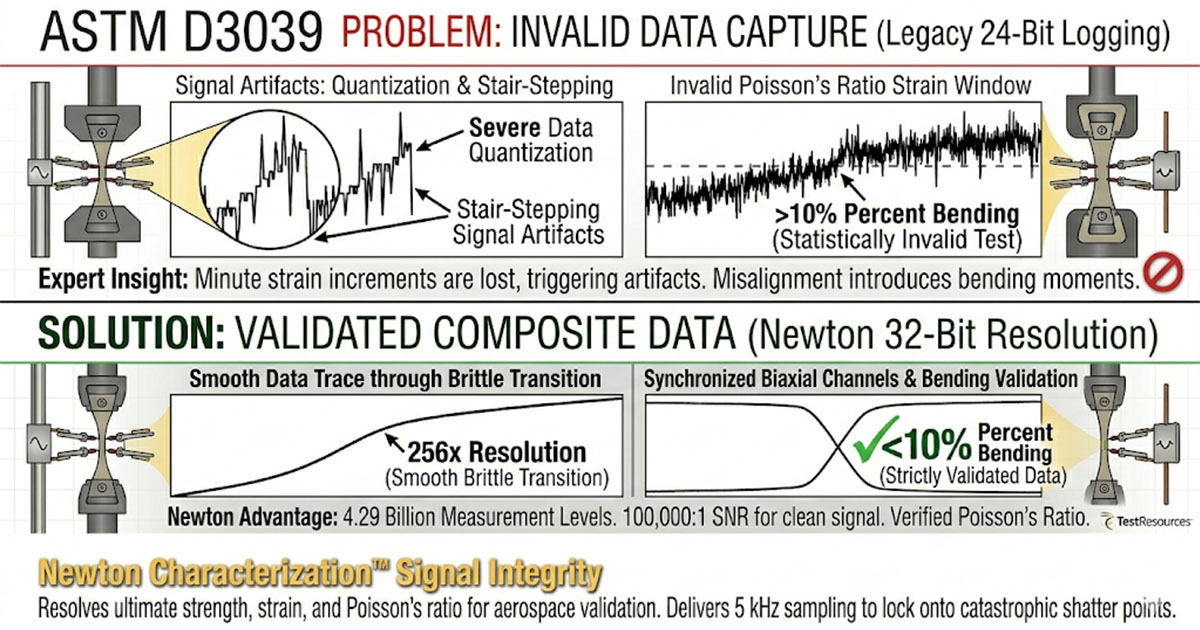
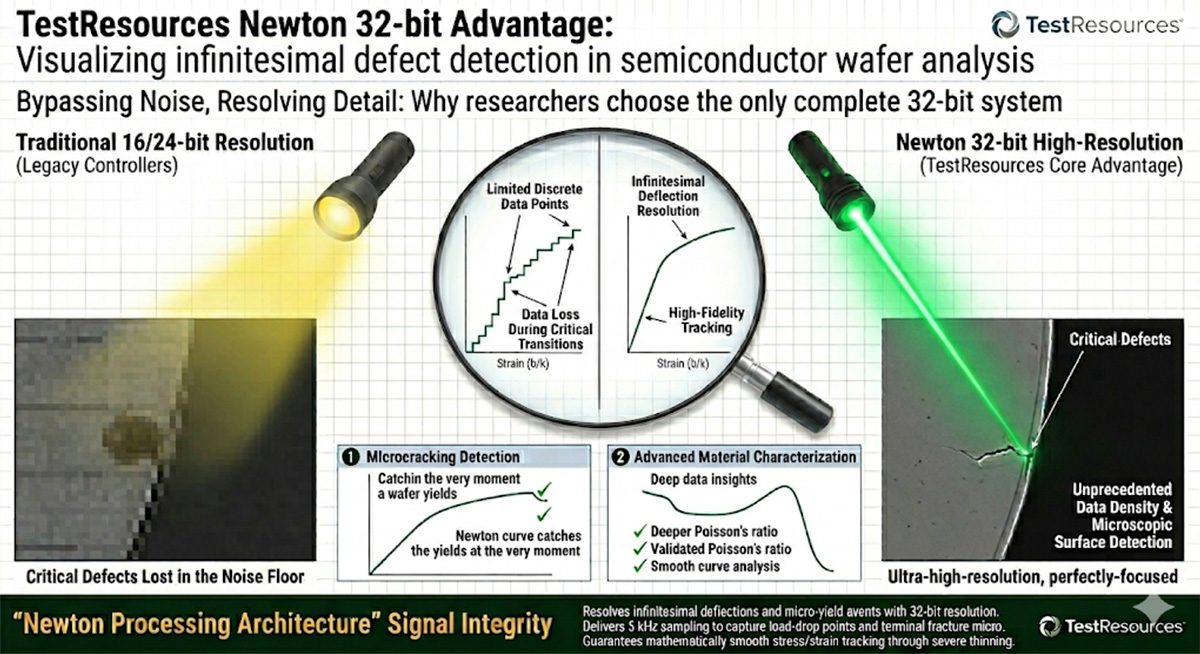
Operates across 4.29 billion discrete measurement levels—providing 256 times the mathematical resolution of legacy 24-bit processors—to trace exceptionally smooth data lines through the brittle composite transition zone.
Delivers a High-Resolution 100,000:1 ratio to completely silence electrical hum and background pump noise, cleanly uncovering the exact material transitions.
Commands high-speed data acquisition up to 5 kHz to lock onto high-energy shatter points and record catastrophic material failures precisely.
Event Detection: Leverages automated high-speed break detection utilities capable of capturing ultimate peak load matrices immediately prior to explosive structural fragmentation.
Calculations: Resolves Ultimate Tensile Strength, Tensile Chord Modulus, Poisson’s Ratio (via synchronized biaxial strain channels), and real-time Percent Bending validation.
Statistical Output: Automatically outputs full batch diagnostics, calculating the statistical Mean, Standard Deviation (SD), and manufacturing batch consistency for aerospace validation.
| Load Frame: | TestResources 316-300-1130 Dual Column Floorstanding UTM |
| Control Architecture: | Newton Characterization™ |
| Software Module: | N-ASTM-D3039 |
| Grips/Fixtures: | G-ASTM-D3039 (High-Capacity Hydraulic/Pneumatic Wedge Grips) |
| Strain Measurement: | E-ASTM-D3039 (TestVE Biaxial Extensometer or Class 0.5 Epsilon Clip-on) |