
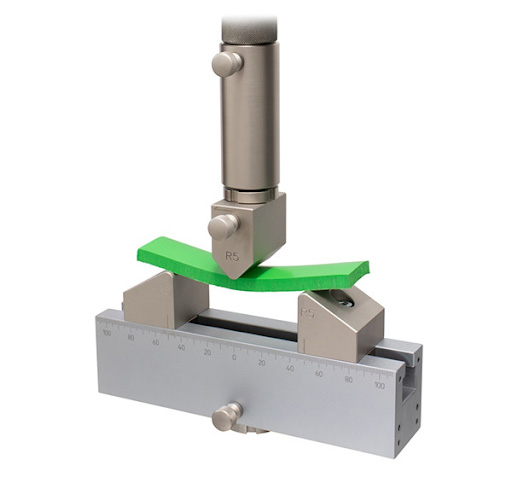
ASTM D790 utilizes a three-point loading system applied to a simply supported beam to determine the flexural strength and stiffness of plastics used in structural components. A major “Measurement Gap” occurs when laboratories attempt to calculate flexural modulus using crosshead displacement data. Measuring crosshead travel includes the structural compliance or “squish” of the support rollers and the machine frame, which can account for up to 20% of the measured displacement in stiff plastics, leading to a massive underestimation of flexural modulus. Furthermore, localized indentation where the loading nose pushes into softer plastics or composites introduces significant measurement errors that must be isolated to yield valid material properties.
To meet the requirements of ASTM D790, MTO recommends the TestResources 312-25-980 dual-column load frame integrated with Newton Characterization™ architecture.
Primary Metric: The system utilizes a three-point bend control mode where the crosshead speed is dynamic. The velocity must be re-calculated and specified for every specimen thickness to maintain a constant 0.01 strain rate throughout the test.
Specimen Geometry: Tests are conducted on unreinforced and reinforced rigid plastics prepared as flat rectangular bars. The loading noses and support rollers must feature precise, standardized radii to prevent localized fiber crushing at contact zones.
Critical Ratios: The support span must be carefully maintained at a mandated span-to-depth ratio (typically 16:1). Deviations or utilizing a span that is too short introduces severe shear interference, which invalidates the flexural calculation.
Problem: Capturing the precise flexural tangent modulus is highly vulnerable to mechanical chatter or structural machine settling, which creates “stair-stepping” signal artifacts and data scatter in the early slope region.
Root Cause: Standard 24-bit controller logic lacks the signal resolution needed to isolate sub-micron mid-span changes under low-load conditions, smoothing out or falsifying the elastic transition zone.
Hardware Solution: MTO mandates a dual-column testing setup with a highly rigid flexure base and adjustable cross-rollers to enforce perfect span symmetry. To completely eliminate frame compliance and local indentation paradoxes, an external direct-contact Epsilon 3540 deflectometer must be placed at the center of the span against the bottom surface of the specimen to track true structural “sag”. Measuring the top surface is unacceptable due to localized nose indentation. The deflection tracking software module must then subtract machine variations in real-time to compute an uncompromised tangent or chord modulus.
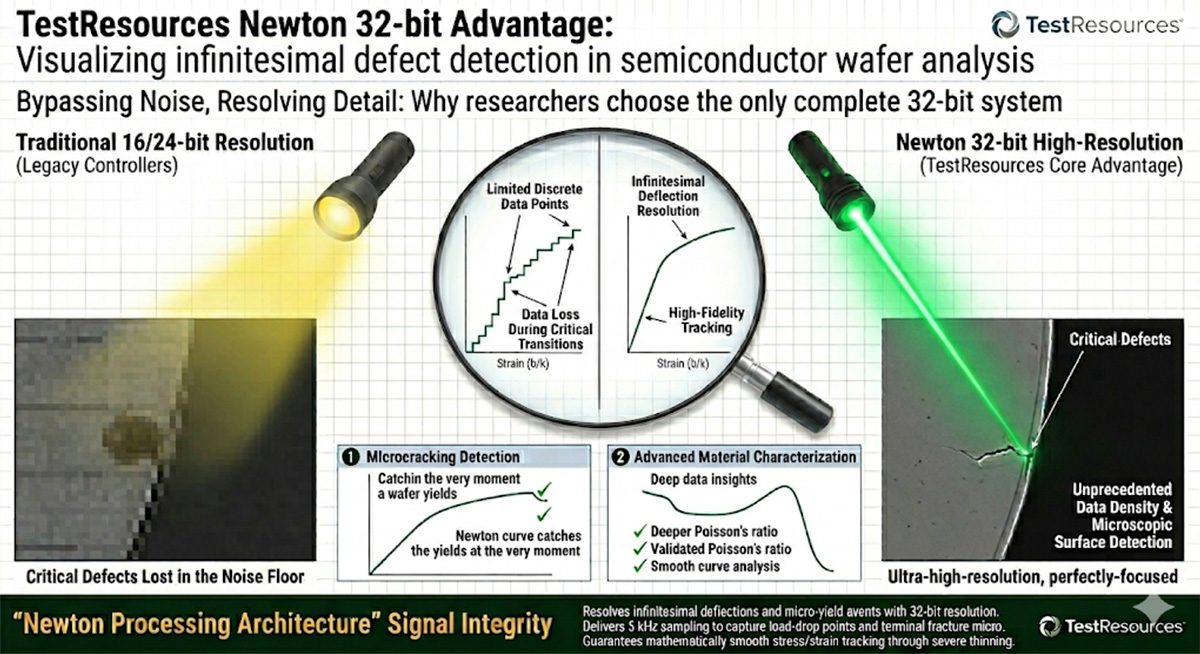
Processed via the Newton digital core yielding 4.29 billion discrete measurement levels (256x greater than legacy 24-bit processors) to resolve infinitesimal mid-span deflections.
Provides a High-Resolution 100,000:1 ratio to completely silence electrical line chatter and motor vibration harmonics from corrupting low-force slope data.
Operates at a rapid 5 kHz data acquisition rate to capture crisp fracture points or localized outer-fiber failures instantly.
Event Detection: Employs an automated break and slope-decay monitor, halting crosshead travel immediately upon reaching structural failure or at a specified 5% strain limit to preserve testing fixtures.
Calculations: Directly calculates Flexural Strength, Tangent Modulus of Elasticity, Secant Modulus, and Flexural Stress at 5% strain.
Statistical Output: Computes integrated batch matrices, summarizing the statistical Mean, Standard Deviation (SD), and cross-specimen batch consistency for audit readiness.
| Load Frame: | TestResources 312-25-980 Dual Column UTM |
| Control Architecture: | Newton Characterization™ |
| Software Module: | N-ASTM-D790 |
| Grips/Fixtures: | G-ASTM-D790 (Three-Point Flexure Fixture Base with Adjustable Span) |
| Strain Measurement: | E-ASTM-D790 (Epsilon 3540 Center-Point Mid-Span Deflectometer) |