
ASTM D882 is the definitive international standard for determining the tensile properties—including tensile strength, yield strength, elongation, and tensile modulus—of thin plastic films and sheeting less than 1.0 mm thick. The primary “Measurement Gap” stems from the fragile nature of thin-gauge films. Unlike standard plastics (ASTM D638), ASTM D882 explicitly forbids dog-bone geometries, mandating straight rectangular strips. This leaves the specimen highly vulnerable to the “Edge Effect”. Any microscopic nick or flaw introduced along the parallel specimen sides by a dull blade will trigger a premature break. Furthermore, because thin films possess almost zero mass, the forces required to stretch a 1-mil poly bag are exceptionally low, meaning standard high-capacity load frames and heavy clip-on extensometers will either cut, tear, or completely overwhelm the specimen signal.
To meet the requirements of ASTM D882, MTO recommends the TestResources 240-250-1040 high-travel single-column frame integrated with Newton Characterization™ architecture.
Primary Metric: This configuration enforces a Constant Rate of Extension (CRE) control mode. The crosshead drives uniform, quasi-static displacement highly dependent on initial grip separation to accurately measure early tensile energy absorption (TEA) and modulus changes.
Specimen Geometry: Tests are executed strictly on straight-sided rectangular film strips exactly 1 inch (25.4 mm) or 0.5 inches wide, ensuring parallel alignment throughout extension.
Critical Ratios: The system must maintain uniform velocity fields across the unconstrained gauge length. Testing should be conducted in both the Machine Direction (MD) and Cross Direction (CD) because film performance is highly anisotropic due to polymer molecular orientation during manufacturing.
Problem: Thin-film stress-strain data is frequently corrupted by “stair-stepping” signal artifacts and erratic elongation spikes during the critical early elastic slope, which misidentifies initial yield limits and compromises modulus repeatability.
Root Cause: Standard 24-bit data acquisition systems lack the sub-gram digital resolution needed to isolate film deformation from ambient mechanical noise. Moreover, manual screw-action grips apply uneven line clamping, causing the fragile sheet to either slide out or instantly shear at the jaw border.
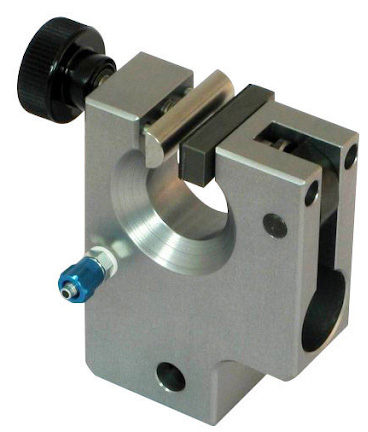
Hardware Solution: MTO mandates the use of a dual-razor industrial film cutter to guarantee perfectly parallel, clean edges on every specimen sheet, eliminating the edge nick paradox. Grip systems must utilize Rubber-Faced Pneumatic Side-Action Grips configured with line-contact or uniform faces. This maintains continuous, constant clamping pressure that automatically follows the material as it thins out, preventing jaw breaks and grip slip.
For strain measurement, traditional contacting extensometers are realistically forbidden. Instead, laboratories must deploy TestVE (Non contacting Extensometry) using an integrated high-resolution macro lens. This non-contacting method tracks the film via high-contrast markings through its entire failure curve without inducing mechanical load bias or physical tearing.
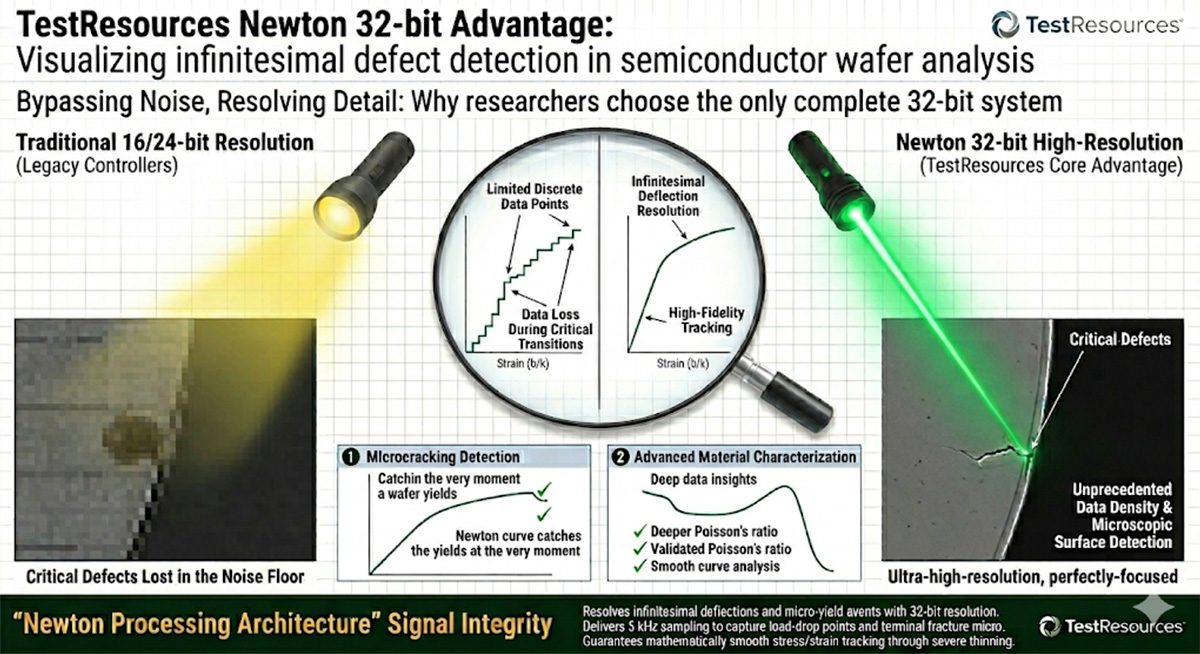
Powered by the Newton processing architecture providing 4.29 billion discrete calculation levels (256x greater than legacy 24-bit hardware), tracing mathematically smooth stress-strain lines through fractions of a gram of material resistance.
Delivers an exceptional 100,000:1 Signal-to-Noise Ratio to completely filter out mechanical frame rumble and background electrical hum, uncovering true low-force properties cleanly.
Commands a rapid 5 kHz data acquisition rate to securely lock onto the precise microsecond of ultimate thin-film tear or rupture.
Event Detection: Employs an automated, high-sensitivity break detection utility configured for ultra-low force percentages, instantly braking crosshead travel at failure to cleanly register thin film snaps without over-travel distortion.
Calculations: Automatically calculates Tensile Energy Absorption (TEA), Tensile Modulus (via initial linear tangent fit), Yield Strength, Tensile Strength at break, and Elongation percentage.
Statistical Output: Computes integrated batch matrices outlining the statistical Mean, Standard Deviation (SD), and manufacturing batch consistency across all film specimens.
| Load Frame: | TestResources 240-250-1040 High-Travel Single Column UTM |
| Control Architecture: | Newton Characterization™ |
| Software Module: | N-ASTM-D882 |
| Grips/Fixtures: | G-ASTM-D882 (Rubber-Faced Pneumatic Side-Action Film Grips) |
| Strain Measurement: | E-ASTM-D882 (TestVE Non-Contacting Extensometry) |