
ASTM E9 serves as the definitive compression equivalent to ASTM E8 tensile testing, playing a vital role in determining the compressive yield strength, yield stress, and Young’s modulus of metallic components. The primary “Measurement Gap” stems from perfect parallelism constraints: if cylinder ends are not ground flat to within 0.001 inches, the sample will kick sideways or barrel unevenly, completely corrupting the data. Because metals possess exceptional structural stiffness, crosshead travel is too noisy and functionally invalid due to system and fixture compliance. Under severe axial loads, metals are highly prone to sudden Euler buckling rather than true material crushing if specimen dimensions or platen mechanics are uncalibrated.
To meet the requirements of ASTM E9, MTO recommends the TestResources 639-2000 floorstanding four-column load frame integrated with Newton Characterization™ architecture.
Primary Metric: This standard enforces strict quasi-static velocity limits, specifying a strain-rate-based control mode (typically 0.005 to 0.15 strain/min) to prevent sudden dynamic momentum from artificially inflating the yield point or inducing localized impact energy absorption.
Specimen Geometry: Tests are conducted on solid metallic cylinders or rectangular prisms. Both ends must be ground perfectly flat and parallel to ensure an identically distributed triaxial stress state.
Critical Ratios: Specimen dimensions must adhere strictly to mandated height-to-diameter slenderness constraints. Using a specimen that is too slender shifts the testing state from true compression yield into structural column buckling.
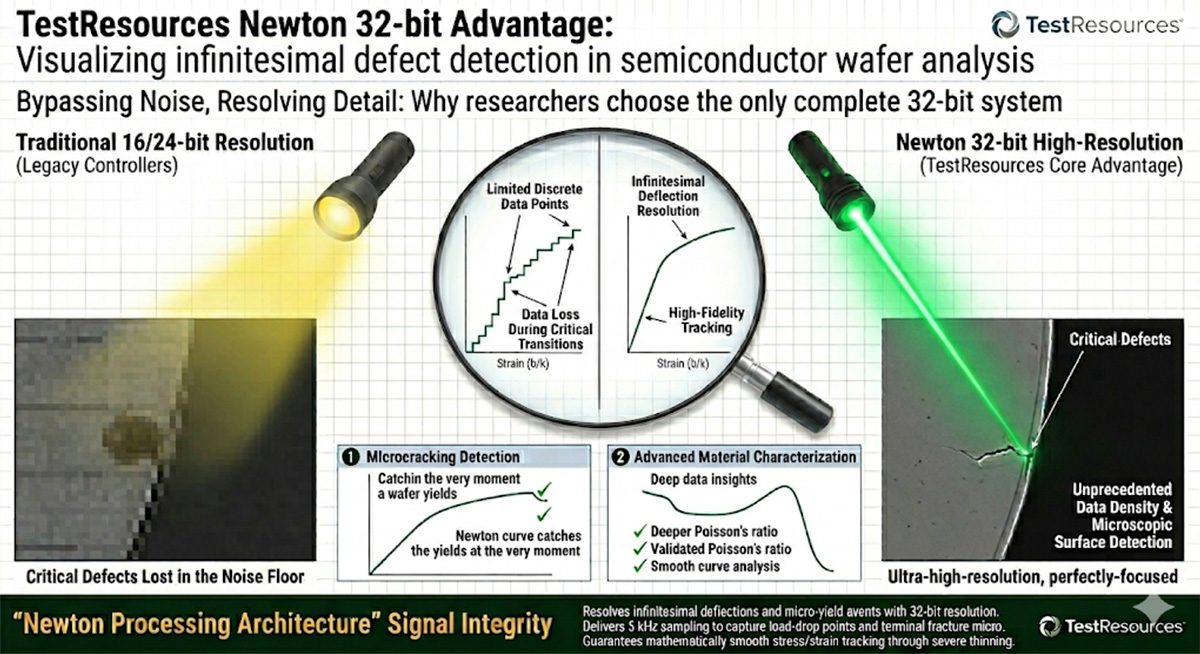
Problem: Brittle transitions, proportional limits, and the initial elastic slope are highly vulnerable to localized mechanical “noise,” which routinely generates “stair-stepping” signal artifacts and data scatter in the early test phase.
Root Cause: Standard 24-bit data acquisition systems lack the discrete resolution needed to isolate sub-micron compression steps, effectively blending structural machine frame deflection with the true microstrain properties of the metal alloy.
Hardware Solution: MTO recommends the use of a high-capacity servohydraulic platform or the use of an integrated G-ASTM-E8 sub-press or spherically seated compression block to automatically compensate for minor specimen non-parallelism. Friction at the platen interface must be minimized by applying a micro-layer of molybdenum disulfide or high-pressure grease to suppress the “barrel effect” and ensure uniform lateral deformation. Crucially, crosshead displacement is completely bypassed for strain tracking in favor of a direct platen-contact E-ASTM-E9 Epsilon 3540 compressometer or deflectometer to measure the gap directly and remove all parasitic frame compliance.
Processed via the Newton digital core to supply 4.29 billion discrete calculation levels (256x greater resolution than legacy 24-bit hardware), tracing smooth, high-fidelity force lines through complex transitions.
Delivers an exceptional 100,000:1 Signal-to-Noise Ratio to completely filter out mechanical frame rumble and electrical motor chatter, cleanly tracking individual high-tension pops.
Commands a rapid 5 kHz internal digital processing loop to securely log the maximum peak force at the exact millisecond of complete structural breakdown.
Event Detection: Employs automated break and slope-decay monitoring utilities to register rapid load fluctuations, halting crosshead travel immediately at failure to protect the specialized sub-press and load cell assemblies.
Calculations: Directly processes and isolates Compressive Yield Strength (calculated via the mathematically robust 0.2% offset method), Young’s Modulus of Elasticity, Proportional Limit, and Ultimate Compressive Strength.
Statistical Output: Generates automated quality control matrices documenting the batch Mean, Standard Deviation (SD), and cross-specimen batch consistency for strict regulatory compliance.
| Load Frame: | TestResources 639H-2000 Floorstanding 4 Column UTM |
| Control Architecture: | Newton Characterization™ |
| Software Module: | N-ASTM-E9 (Supporting Toe-Compensation & Closed-Loop Strain Control) |
| Grips/Fixtures: | G-ASTM-E9 (Spherically Seated Compression Platens / Sub-Press Assembly) |
| Strain Measurement: | E-ASTM-E9 (Epsilon 3540 Center-Point Deflectometer / Compressometer) |